

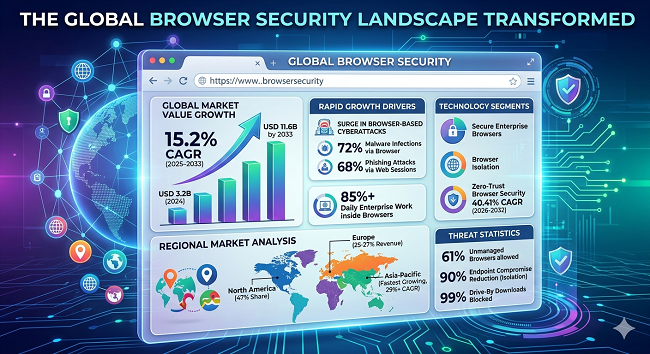
The global browser security landscape has transformed rapidly as web browsers become the primary gateway for enterprise applications, SaaS platforms, and digital workflows. According to industry insights highlighted by Marketintelo, the global browser security market was valued at USD 3.2 billion in 2024 and is projected to reach USD 11.6 billion by 2033, expanding at a CAGR of 15.2%.
The rapid growth is largely driven by the surge in browser-based cyberattacks. Studies show that 72% of enterprise malware infections originate from browser-based vectors, while 68% of phishing attacks are delivered through web sessions, highlighting the browser as one of the most vulnerable digital entry points.
With more than 85% of daily enterprise work now occurring inside browsers, organizations are shifting cybersecurity investments toward advanced browser security platforms, isolation technologies, and zero-trust frameworks.
Key Numerical Highlights of the Browser Security Industry
- Global browser security market size: USD 3.2B (2024)
- Projected market value: USD 11.6B by 2033
- Global CAGR (2025–2033): 15.2%
- Zero-trust browser security market (2025): USD 0.65B
- Expected value by 2032: USD 4.98B
- Forecast CAGR (2026–2032): 40.41%
- Enterprises allowing unmanaged browser access: 61%
- Browser-based malware incidents: 72% of total infections
- Reduction in endpoint compromise via browser isolation: up to 90%
- Remote browser isolation blocking drive-by downloads: 99% success rate
These statistics highlight why browser security is emerging as one of the fastest-growing segments within the global cybersecurity ecosystem.
Historical Market Growth (2016–2024)
Over the past decade, the browser security market has steadily expanded due to cloud adoption, hybrid work models, and increased regulatory compliance requirements.
Historical Market Evolution
- 2016–2018: Growth driven by basic endpoint browser protection tools.
- 2019–2021: Surge in browser-based threats and phishing campaigns.
- 2022–2024: Enterprises adopted secure enterprise browsers and zero-trust models.
Between 2024 and 2033, the market is expected to more than triple in value, driven by enterprise digital transformation initiatives and advanced threat detection technologies.
Year-Over-Year Market Comparisons
Year-wise comparisons reveal consistent expansion in the browser security market:
| Year | Market Size (USD Billion) | Growth Trend |
| 2020 | ~2.1 | Early enterprise adoption |
| 2022 | ~2.7 | Cloud-based security growth |
| 2024 | 3.2 | Zero-trust adoption rising |
| 2026 | ~4.3 (est.) | Rapid enterprise demand |
| 2033 | 11.6 | Large-scale market maturity |
This progression represents over 260% total market growth from 2024 to 2033.
Enterprise Browser Security Segment Expansion
Enterprise-focused browser security solutions are experiencing particularly strong demand.
- Enterprise browser security market: USD 3.40B in 2025
- Projected market size: USD 8.46B by 2030
- Forecast CAGR: 20% (2026–2030)
Large enterprises account for 63% of total browser security spending, due to complex IT environments and higher exposure to cyber threats.
Small and medium enterprises (SMEs) represent the fastest-growing segment, with 16.8% projected CAGR through 2033, driven by cloud security adoption and remote workforce growth.
Browser Security Technology Segments
The browser security ecosystem includes several specialized technologies:
1. Secure Enterprise Browsers
- Market value: USD 7.2B in 2024
- Forecast: USD 29.1B by 2033
- CAGR: 17.4%
These hardened browsers include built-in threat detection, secure session management, and policy enforcement.
2. Browser Isolation Software
- Market size: USD 184.47M (2026)
- Forecast: USD 339.66M by 2035
- CAGR: 6.9%
3. Zero-Trust Browser Security
- Market size: USD 0.65B (2025)
- Forecast: USD 4.98B by 2032
- CAGR: 40.41%
Zero-trust architecture represents the fastest-growing technology category within browser security.
Regional Market Analysis
North America
- Market share: 47% in 2025
- Leading adoption region due to strict cybersecurity frameworks and federal zero- trust mandates.
The United States accounts for approximately 38% of global browser isolation deployments, supported by high enterprise digitization rates.
Europe
Europe represents roughly 25–27% of global browser security revenue, driven by strong regulatory frameworks such as GDPR and growing investments in enterprise cybersecurity.
Asia-Pacific
Asia-Pacific is the fastest-growing region, expected to achieve 29%+ CAGR through 2031 in related browser isolation technologies.
Countries like India, China, and Japan are investing heavily in cybersecurity infrastructure due to rapid digital transformation.
Latin America and Middle East & Africa
Combined, these regions represent approximately 10–12% of the global browser security market, but adoption is increasing due to cloud migration and digital government initiatives.
Cyber Threat Statistics Driving Browser Security Demand
Browser-based threats have escalated significantly over the past decade.
Major Threat Metrics
- 72% of malware infections originate from browser activity
- 68% of phishing attacks occur via web sessions
- 44% increase in attack surface due to unmanaged browsers
- 61% of enterprises allow cloud access via unmanaged browsers
- 99% of drive-by downloads blocked using remote browser isolation
In addition, web application security markets are also expanding rapidly, growing from USD 4.48 billion in 2025 to USD 16.16 billion by 2033, further reinforcing the need for robust browser security frameworks.
Competitive Landscape and Industry Players
The browser security market features a mix of cybersecurity giants and specialized startups.
Leading Industry Vendors
- Microsoft
- Cisco
- Palo Alto Networks
- Zscaler
- Cloudflare
- Netskope
- Check Point Software Technologies
- Fortinet
The top three vendors collectively control approximately 61.4% of total market revenue, indicating moderate industry concentration with strong competition from emerging cybersecurity startups.
Many vendors are integrating AI-driven threat detection, behavioral analytics, and secure browser extensions into their security platforms.
Future Outlook: 2030–2035 Market Projections
Industry forecasts suggest continued strong expansion of browser security technologies. Key Forecast Metrics
- Global market: USD 11.6B by 2033
- Secure browser market: USD 29.1B by 2033
- Browser security platform market: USD 15.71B by 2033
- Enterprise browser security market: USD 8.46B by 2030
The next phase of growth will likely be driven by:
- AI-powered threat detection
- Zero-trust architecture implementation
- SaaS application security
- Cloud-native browser security solutions
- Government cybersecurity mandates
Conclusion: Browser Security Becomes a Core Cybersecurity Investment
The browser security market is transitioning from a niche cybersecurity segment to a foundational pillar of enterprise protection. From USD 3.2 billion in 2024 to USD 11.6 billion by 2033, the industry is projected to grow at a 15.2% CAGR, fueled by rising browser-based cyber threats and widespread cloud adoption.
Zero-trust browser security alone is forecast to expand from USD 0.65 billion in 2025 to USD 4.98 billion by 2032, representing one of the fastest-growing cybersecurity domains.
With over 85% of enterprise workflows now happening within browsers and 72% of malware entering through browser channels, organizations worldwide are increasing investments in browser security platforms, secure enterprise browsers, and isolation technologies.
By 2033–2035, browser security is expected to become one of the most critical cybersecurity investment categories as enterprises prioritize secure web access, data protection, and zero- trust digital infrastructure.
Read A Full Report: https://marketintelo.com/report/browser-security-market