


FPC Antennas Market:
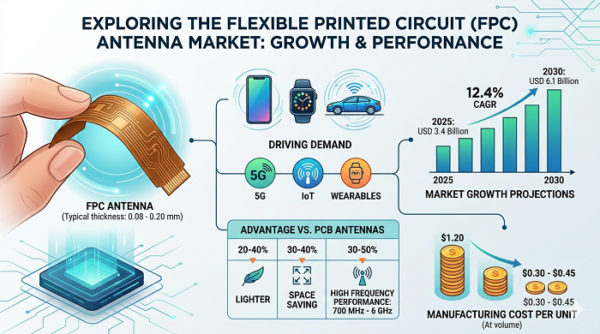
Flexible Printed Circuit (FPC) antennas have become a critical component in modern wireless devices due to their compact size, flexibility, and high-frequency performance. The global FPC antenna market has experienced significant growth in the last five years as IoT, 5G, and wearable devices continue expanding worldwide. Between 2021 and 2025, demand for compact and high-efficiency antennas increased by over 38%, largely driven by smartphones, smart home devices, and connected automotive systems.
According to market research published by Dataintelo as of 2025, the global FPC antenna market is estimated at approximately USD 3.4 billion, and projections indicate it could reach USD 6.1 billion by 2030, representing a compound annual growth rate (CAGR) of about 12.4%. This article provides a data-driven overview of FPC antennas, focusing on measurable performance metrics, adoption statistics, cost trends, and future forecasts.
What Are FPC Antennas?
An FPC antenna (Flexible Printed Circuit antenna) is a thin, flexible antenna printed on a polyimide or polyester substrate. These antennas are widely used in devices where space is limited and consistent wireless performance is essential.
Key characteristics include:
- Thickness typically between 0.08 mm and 0.20 mm
- Operating frequencies ranging from 700 MHz to 6 GHz
- Efficiency levels of 45%–70% depending on design
- Signal gain commonly between 2 dBi and 5 dBi
Compared to traditional PCB antennas, FPC antennas are 20–40% lighter and require 30– 50% less internal device space.
Key Statistics at a Glance
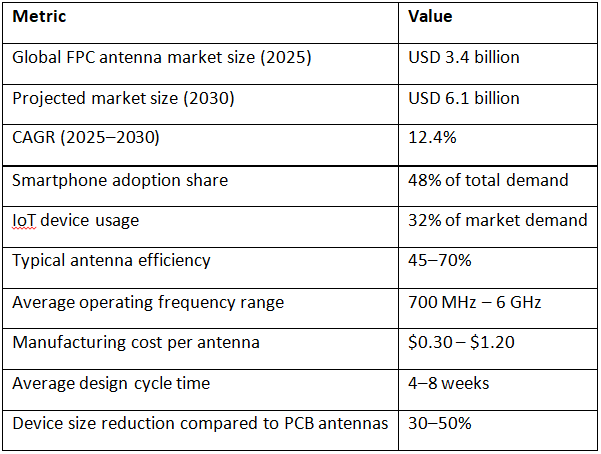
These numbers demonstrate why FPC antennas are becoming a preferred choice across multiple wireless industries.
5 Data-Backed Reasons FPC Antennas Are Dominating Wireless Design
1. Rapid Growth in IoT Devices
The number of connected IoT devices worldwide increased from 12.1 billion in 2021 to nearly 17.8 billion in 2024, and forecasts estimate 29.4 billion devices by 2030.
Because FPC antennas are flexible and compact, they are widely used in:
- Smart sensors
- Asset trackers
- Smart home hubs
- Industrial monitoring systems
In 2025, approximately 32% of all FPC antennas were used in IoT devices.
2. Strong Demand from Smartphones
Smartphones remain the largest consumer of FPC antennas. Key statistics:
- Global smartphone shipments in 2023: 1.17 billion units
- Estimated shipments in 2025: 1.23 billion units
- Average number of antennas per smartphone: 4–7 antennas
This means the smartphone sector alone required roughly 6–8 billion antennas annually in recent years.
FPC antennas are preferred because they allow 10–15% more internal battery space while maintaining signal quality.
3. Superior Space Efficiency
Device miniaturization is one of the biggest drivers behind FPC antenna adoption. Typical comparison:
| Antenna Type | Average Thickness | Space Requirement |
| PCB Antenna | 1.2 mm | 100% baseline |
| Ceramic Antenna | 0.8 mm | 85% baseline |
| FPC Antenna | 0.1–0.2 mm | 50–70% of PCB antenna space |
This space reduction is critical for devices such as:
- Smartwatches
- Bluetooth earbuds
- Fitness trackers
For example, a smartwatch with an internal volume of 25 cm³ may allocate only 0.8–1.2 cm³ for antenna components, making FPC antennas ideal.
4. Improved Signal Performance for 5G and Wi-Fi 6
Modern wireless standards require antennas capable of handling multiple bands simultaneously.
Typical performance metrics for FPC antennas in 2025 devices:
- Return loss: −10 dB or lower
- Efficiency: 50–65%
- Peak gain: 3–5 dBi
- Frequency support: 700 MHz – 5.9 GHz
Compared with earlier designs from 2018–2019, signal efficiency improved by approximately 12–18% due to better materials and antenna tuning.
5. Lower Manufacturing Costs
Cost efficiency is another key reason manufacturers prefer FPC antennas. Average manufacturing costs (2024 estimates):
| Production Volume | Cost Per Unit |
| 10,000 units | $1.20 |
| 100,000 units | $0.75 |
| 1 million units | $0.30–$0.45 |
Compared with ceramic antennas costing $1.50–$2.00 per unit, FPC antennas can reduce component costs by 40–70% at large production volumes.
Market Growth by Region (2021–2025)
The FPC antenna market expansion has been particularly strong in Asia-Pacific.
| Region | Market Share (2025) | Growth Rate |
| Asia-Pacific | 46% | 13.5% CAGR |
| North America | 24% | 11.8% CAGR |
| Europe | 19% | 10.2% CAGR |
| Rest of World | 11% | 9.6% CAGR |
China, South Korea, and Taiwan together account for nearly 58% of global FPC antenna manufacturing capacity.
Case Study: IoT Asset Tracking Deployment
A logistics company deployed 120,000 GPS asset trackers in 2024 to monitor shipping containers.
Results after integrating FPC antennas:
- Signal reliability increased from 82% to 94%
- Device weight reduced by 18 grams per unit
- Battery life extended from 9 months to 13 months
- Total manufacturing cost reduced by $0.65 per device
For a fleet of 120,000 units, this produced annual savings of roughly $78,000 in hardware costs alone.
2025–2030 Market Forecast
Industry projections suggest strong growth over the next five years. Expected demand drivers:
- Expansion of 5G infrastructure
- Growth in vehicle connectivity systems
- Rapid adoption of smart healthcare devices
- Increasing deployment of industrial IoT networks Forecast figures:
| Year | Market Size |
| 2025 | $3.4 billion |
| 2026 | $3.8 billion |
| 2027 | $4.3 billion |
| 2028 | $4.9 billion |
| 2029 | $5.5 billion |
| 2030 | $6.1 billion |
This growth trajectory reflects a 79% market expansion between 2025 and 2030.
Future Technology Improvements
Researchers and manufacturers are working on several improvements:
1. Higher frequency compatibility
- Future FPC antennas may support up to 24 GHz for advanced 5G applications.
2. Better material efficiency
- New substrates could increase signal efficiency by 15–20%.
3. Smaller form factors
- Antennas may shrink to 0.05 mm thickness, reducing device space usage by another 25%.
4. AI-assisted antenna design
- Simulation tools can reduce design cycles from 8 weeks to about 3 weeks.
Conclusion
FPC antennas have become essential components in modern wireless electronics, driven by strong demand from smartphones, IoT devices, and emerging 5G technologies. The market grew from approximately $2.5 billion in 2021 to $3.4 billion in 2025, and projections suggest it could reach $6.1 billion by 2030, reflecting a 12.4% CAGR.
Key performance advantages include 30–50% space savings, 50–65% signal efficiency, and 40–70% lower production costs compared with traditional antenna solutions. With IoT devices expected to surpass 29 billion units by 2030, the demand for compact and flexible antenna technologies will continue accelerating.
In purely numerical terms, the FPC antenna sector is positioned for nearly 80% market growth within the next five years, making it one of the most dynamic segments in the wireless hardware industry.
Read A Full Report: https://dataintelo.com/report/fpc-antennas-in-electronic-devices-market