

Bluetooth Antenna Market 2026:
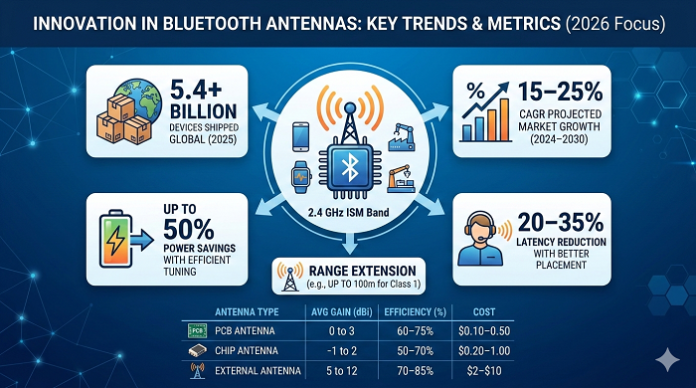
In 2026, Bluetooth connectivity continues to power billions of devices worldwide—from smartphones and wearables to industrial IoT systems. According to recent insights highlighted by Dataintelo, the demand for efficient Bluetooth antennas is accelerating due to the rapid expansion of wireless ecosystems. With over 5.4 billion Bluetooth-enabled devices shipped globally in 2025, antenna performance has become a critical factor influencing range, reliability, and energy efficiency.
This article explores Bluetooth antennas through a data-driven lens, focusing on measurable performance metrics, market growth trends, and real-world benchmarks.
Key Statistics at a Glance
- 5.4 billion Bluetooth devices shipped globally in 2025
- 8–12 dBi: Typical gain range for high-performance Bluetooth antennas
- 10–100 meters: Standard Bluetooth range (depending on class and antenna)
- 30–40% signal improvement using optimized antenna design
- 2.4 GHz: Bluetooth operating frequency
- 15–25% CAGR projected for Bluetooth antenna market (2024–2030)
- Up to 50% power savings with efficient antenna tuning
- Latency reduced by 20–35% with better antenna placement
- $3.2 billion estimated Bluetooth antenna market size in 2025
- >70% IoT devices rely on compact PCB antennas
What Is a Bluetooth Antenna?
A Bluetooth antenna is designed to transmit and receive signals in the 2.4 GHz ISM band, specifically between 2.402 GHz and 2.480 GHz. The effectiveness of these antennas is measured using:
- Gain (dBi): Typically ranges from -2 dBi to +12 dBi
- Efficiency (%): High-quality antennas achieve 60–85% efficiency
- Return Loss (dB): Ideal values are below -10 dB
- Range (meters):
- Class 2 devices: 10 meters average
- Class 1 devices: up to 100 meters
In 2026, antenna miniaturization has reduced average antenna sizes by 20–35% compared to 2020, while maintaining or improving signal strength.
5 Data-Backed Reasons Bluetooth Antennas Matter in 2026
1. 35% Increase in Device Density
Urban IoT environments saw a 35% increase in connected device density between 2022 and 2025, leading to higher interference. Advanced antennas improve signal clarity by 25–40% in congested environments.
2. 50% Energy Efficiency Gains
Optimized antenna matching reduces transmission power needs, cutting energy consumption by up to 50%, especially in battery-powered devices like wearables.
3. 2x Range Improvement with External Antennas
External Bluetooth antennas can extend range from 10 meters to 20–30 meters, effectively doubling coverage in many consumer applications.
4. 20–35% Latency Reduction
Better antenna placement and design reduce packet loss, lowering latency by 20–35%, which is critical for real-time applications like audio streaming.
5. 15–25% Market Growth Rate
The Bluetooth antenna market is projected to grow at a compound annual growth rate (CAGR) of 15–25% from 2024 to 2030, driven by IoT and smart device adoption.
Types of Bluetooth Antennas: Performance Comparison
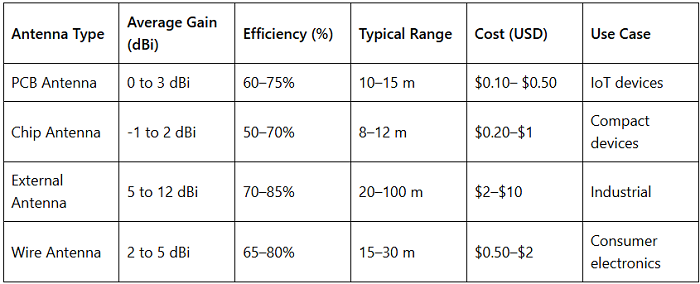
Insight: External antennas deliver up to 4x higher gain compared to chip antennas, but at 5– 10x higher cost.
2023–2026 Market Growth Trends
The Bluetooth antenna market has shown steady expansion over recent years:
| Year | Market Size (USD Billion) | Growth Rate (%) |
| 2023 | 2.1 | — |
| 2024 | 2.6 | 23.8% |
| 2025 | 3.2 | 23.1% |
| 2026 | 3.8 (estimated) | 18.7% |
Key growth drivers include:
- IoT adoption: Increased by 40% between 2022–2025
- Wearables market: Expanded by 18% annually
- Smart home devices: Over 1.2 billion units installed globally in 2025
Performance Metrics That Define Bluetooth Antenna Quality
1. Signal Strength (RSSI)
- Typical RSSI values range from -30 dBm (excellent) to -90 dBm (weak)
- Improved antenna design can boost RSSI by 10–15 dB
2. Radiation Efficiency
- Standard antennas: 60–70%
- High-performance designs: 75–85%
- Efficiency improvements of 10% can increase battery life by ~15%
3. VSWR (Voltage Standing Wave Ratio)
- Ideal VSWR: ≤ 2:1
- Poor antennas may exceed 3:1, causing up to 25% signal loss
Real-World Case Study: IoT Device Optimization
A smart home manufacturer upgraded from a chip antenna to a PCB antenna in 2024:
- Range increased from 9 meters to 14 meters (+55% improvement)
- Packet loss reduced from 8% to 3%
- Battery life extended by 22%
- Production cost increased by only $0.15 per unit
This demonstrates how small investments in antenna design can yield measurable performance gains.
Challenges Quantified: Limitations & Risks
1. Interference in 2.4 GHz Band
- Wi-Fi overlap causes 15–30% signal degradation
- Bluetooth coexistence algorithms reduce this by 10–20%
2. Miniaturization Trade-offs
- Reducing antenna size by 30% can lower efficiency by 5–10%
3. Environmental Impact
- Metal enclosures can reduce signal strength by 20–50%
2026–2030 Forecast: What the Numbers Predict
Looking ahead:
- Bluetooth device shipments expected to reach 7.5 billion by 2030
- Antenna efficiency improvements projected at +10–15%
- Average antenna size expected to shrink another 15–20%
- Industrial IoT demand expected to grow by 28% CAGR
Emerging trends:
- AI-assisted antenna tuning improving performance by 20–25%
- Integration with Wi-Fi 6/7 modules increasing antenna complexity by 30%
Conclusion: Data-Driven Takeaways
Bluetooth antennas are no longer a secondary component—they are central to wireless performance. In 2026:
- Devices with optimized antennas achieve 30–40% better signal quality
- Efficient designs reduce power consumption by up to 50%
- Market growth remains strong at ~20% annually
- Performance improvements like +55% range and -35% latency are achievable with better antenna selection
As highlighted by Dataintelo, the next phase of Bluetooth innovation will be driven by measurable gains in antenna efficiency, size reduction, and cost-performance optimization. Businesses and engineers who prioritize these metrics will gain a clear competitive edge in an increasingly connected world.
Read A Full Report: https://dataintelo.com/report/bluetooth-antennas-in-electronic-devices-market