

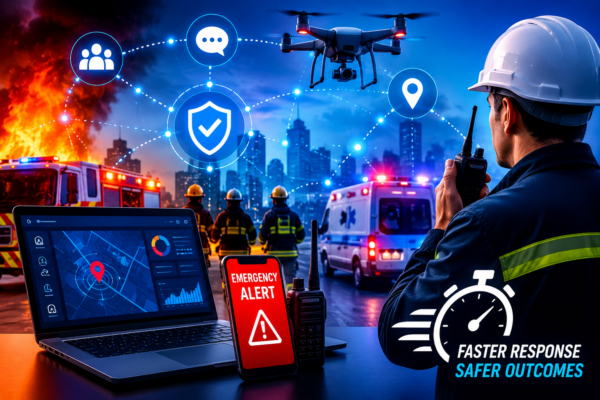
When a critical incident occurs, whether it is a fire, cyberattack, medical emergency, infrastructure failure, security threat, or natural disaster, time immediately becomes the most valuable resource available.
Every minute can influence outcomes. Delays in communication, decision-making, resource allocation, or situational awareness can significantly increase operational disruption, financial losses, and risks to human safety.
As a result, organizations across both public and private sectors are increasingly investing in technologies specifically designed to improve response speed, coordination, and decision-making.
The growing importance of these technologies reflects a simple reality: successful emergency response is no longer determined solely by people and procedures. It increasingly depends on the tools available to support them.
Why Speed Matters in Critical Response
The first stage of any emergency is often characterized by uncertainty.
Decision-makers may have incomplete information. Response teams may be located in different areas. Stakeholders may be seeking updates while the situation continues to evolve.
Research into emergency management consistently highlights the importance of rapid information sharing and situational awareness. Technologies that improve visibility and communication help organizations reduce confusion, improve coordination, and accelerate decision-making during emergencies. Solutions such as emergency response software are helping organizations centralize information, coordinate teams, and maintain visibility during fast-moving incidents where every second matters
The faster organizations can understand what is happening, the faster they can begin taking effective action.
Emergency Management Platforms: The Modern Command Center
One of the most significant developments in recent years has been the rise of emergency management and incident response platforms.
These systems serve as digital command centers that bring together critical information, communication tools, response plans, resource tracking, and incident documentation within a single environment.
Modern emergency response management systems are designed to coordinate responsibilities, track actions, manage escalation procedures, and support decision-making throughout the lifecycle of an incident.
Rather than relying on disconnected spreadsheets, phone calls, and emails, organizations can maintain a shared operational picture that allows all stakeholders to work from the same information.
Real-Time Communication Systems
Communication failures remain one of the most common challenges during emergencies.
When information becomes fragmented, teams can duplicate efforts, overlook critical tasks, or make decisions based on outdated information.
Modern response technologies address this challenge through:
- Mass notification systems
- Mobile emergency alerts
- Secure communication platforms
- Multi-channel messaging tools
- Integrated responder communications
These solutions ensure that information reaches the right people quickly, regardless of their location. Advanced communication technologies have become a cornerstone of modern emergency management because they support coordination across multiple teams and agencies.
Situational Awareness Through Data Integration
A major challenge during emergencies is maintaining an accurate understanding of rapidly changing conditions.
This is where situational awareness technologies play a crucial role.
Modern platforms increasingly integrate data from:
- Building management systems
- Access control systems
- Environmental sensors
- CCTV networks
- Geographic information systems (GIS)
- Asset tracking platforms
By bringing these information sources together, organizations can create a real-time operational picture that supports faster and more informed decision-making. Enhanced situational awareness is widely recognized as one of the most important benefits of modern emergency management technology.
Artificial Intelligence and Predictive Analytics
Artificial intelligence is beginning to play an increasingly important role in emergency response.
Rather than simply reacting to incidents, AI-powered systems can help organizations anticipate potential problems before they escalate.
Applications include:
- Predictive risk analysis
- Threat detection
- Resource optimization
- Incident prioritization
- Pattern recognition across large datasets
AI can analyze vast quantities of information far more quickly than human operators, helping leaders identify emerging threats and make more informed decisions under pressure.
Although human judgment remains essential, AI is becoming an important decision-support tool in time-critical environments.
Drones and Remote Monitoring Technologies
Certain emergencies occur in environments that are difficult or dangerous for responders to access immediately.
In these situations, drones and remote monitoring systems can provide valuable intelligence.
Modern drone technologies are increasingly used for:
- Search and rescue operations
- Fire monitoring
- Infrastructure inspections
- Hazard identification
- Disaster assessment
These systems provide real-time visual information that can improve situational awareness while reducing risks to response personnel. Research continues to demonstrate the growing potential of drone technologies to support emergency monitoring and disaster response activities.
Digital Twins and Facility Mapping
Understanding the physical environment is essential during many emergency scenarios.
Digital twins and advanced facility mapping technologies allow organizations to create detailed virtual representations of buildings, infrastructure, and operational environments.
These tools can support:
- Emergency planning
- Evacuation route design
- First responder familiarization
- Training exercises
- Hazard identification
By providing accurate spatial information, digital twins help responders navigate complex environments more effectively and make faster operational decisions.
Simulation and Training Technologies
Technology is also transforming how organizations prepare for emergencies before they occur.
Advanced simulation platforms allow teams to practice responses in realistic virtual environments without exposing people or assets to risk.
Modern training technologies can recreate:
- Major incidents
- Cybersecurity breaches
- Multi-agency emergencies
- Industrial accidents
- Natural disasters
These simulations help organizations identify weaknesses, improve coordination, and build confidence among response teams. Training systems that replicate real-world conditions have become increasingly valuable for preparing leaders and responders to perform effectively under pressure.
Incident Management Software and Structured Decision-Making
As incidents become more complex, maintaining structure becomes increasingly important.
Incident management systems provide frameworks for assigning responsibilities, tracking actions, documenting decisions, and managing escalation processes.
Effective systems support:
- Clear role assignment
- Real-time task management
- Decision logging
- Escalation tracking
- Operational reporting
These capabilities help organizations maintain control during rapidly evolving situations and ensure accountability throughout the response process. Strong incident management systems are designed specifically to improve decision-making and coordination during high-pressure events.
The Growing Importance of Interoperability
Modern emergencies rarely involve a single team or department.
Large-scale incidents often require coordination between security teams, facilities managers, emergency services, technology providers, healthcare organizations, and government agencies.
As a result, interoperability has become a critical design principle for emergency response technology.
Systems must be capable of sharing information across multiple platforms and organizations while maintaining security and reliability. The ability to connect different stakeholders through common operational systems significantly improves coordination during complex incidents.
From Reactive Response to Operational Resilience
Perhaps the most significant shift in emergency management technology is the move away from purely reactive approaches.
Modern technologies increasingly focus on:
- Prevention
- Preparedness
- Early detection
- Predictive analysis
- Continuous monitoring
Rather than waiting for incidents to occur, organizations are using technology to identify vulnerabilities, improve readiness, and strengthen resilience before crises emerge.
This proactive approach allows organizations to reduce risks while improving their ability to respond when disruption inevitably occurs.