


Gen Z AI Usage in India – India’s Gen Z is gradually making room for artificial intelligence in everyday decision-making, but the generation does not appear ready to hand over the reins completely, reveals Rukam Capital, a venture capital firm investing in early-stage brands.
In its latest consumer study, titled “Gen Z: A Deep Dive into India’s Most Influential Consumer Cohort,” conducted in collaboration with YouGov, demonstrates a stark difference in how young consumers uses AI at a first place. They are comfortable with AI recommending products or services, helping them compare options and even supporting decisions around healthcare, education and finances. However, when Gen Z was asked about giving AI full control over final decision-making, the comfort drops to a certain extent.
The findings charts emerging consumer expectation around AI: Gen Z appears to prefer AI as a decision-support system rather than a decision-maker.
AI Emerges as a Shopping Co-Pilot, Not Just a Search Tool
AI has silent build its place in the Gen Z purchase journey, already. Nearly 60% of respondents say they use AI at times when deciding what to buy, while only 14% say they have never used AI for shopping.
But what they use it for is perhaps more significant than how often they use it.
The most common usage is centered on evaluation and comparison. About 31% use AI to compare products/services or brands, while 29% use it to find the best price or deal. Another 29% use it to understand product features and specifications.
The role of AI continues further down the purchase funnel. Around 24% use it to assess whether a product or service is worth buying, while 22% use it to find alternatives to products they are already considering. Another 22% use AI to read or summarise reviews.
Interestingly, discovering new brands or products ranks among the less common applications, at 17%.
The pattern suggests that, for Gen Z, AI is currently playing a stronger role as an evaluation layer than as a discovery engine. Instead of replacing the entire shopping journey, it is helping consumers process information faster, compare options and arrive at a more informed choice.
For brands, this could make the AI-readiness of their digital presence increasingly important. Being discoverable online may no longer be enough. Product information, specifications, pricing, reviews and other details may need to be structured in ways that can be understood and processed by AI-led interfaces.
Gen Z trust AI recommendation, but comfort drops in giving control over final decisions
The same distinction emerges when respondents are asked about AI’s role beyond shopping.
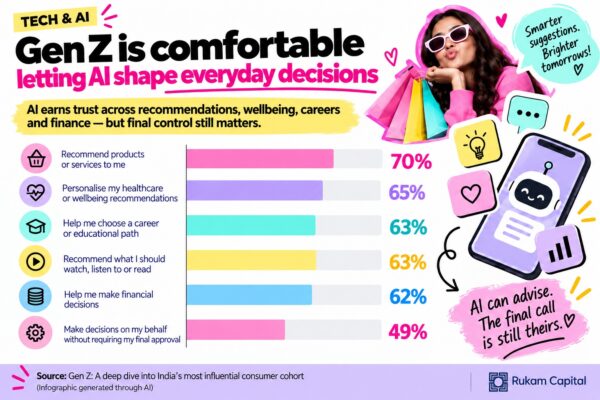
As many as 70% say they are comfortable with AI recommending products or services, indicating a high degree of openness to AI-assisted choices.
That comfort extends to several relatively personal areas. Around 65% are comfortable with AI personalising healthcare or wellbeing recommendations, while 63% are comfortable using AI to help choose a career or educational path. An equal 63% are comfortable with AI recommending what they should watch, listen to or read.
Financial decisions are also entering the AI-assisted zone, with 62% comfortable with AI helping them make financial decisions.
However, there is a noticeable drop when AI moves from recommendation to autonomy.
Only 49% are comfortable with AI making decisions on their behalf without requiring their final approval.
The distinction is important. Gen Z does not appear to be resisting AI itself. Instead, the data suggests that it is drawing a line between being assisted by AI and being replaced by it in the decision-making process.
For technology companies, this could influence how the next generation of AI products is designed. Features that explain recommendations, offer choices and allow users to retain final approval may align more closely with this preference than systems that operate entirely without human intervention.
Gen Z is deeply reliant on the internet, with many feeling uneasy when offline
The growing role of AI is taking place against a much broader backdrop of technology dependence.
For Gen Z, digital technology is no longer confined to specific activities such as entertainment, shopping, or communication. 72% say their smartphone would be the hardest device to give up for a month, while 57% say the same about internet or Wi-Fi access.
The dependence extends throughout everyday life. About 71% say they rely on technology for most aspects of their daily lives, while 78% believe technology makes their lives significantly easier.
Yet, the same generation also appears conscious of the trade-off that comes with this convenience.
Nearly 74% admit that they sometimes spend more time online than they had intended, while 64% say they consciously try to take breaks from digital devices. Another 65% report feeling uncomfortable when they cannot access the internet.
That creates another layer of the technology story. Gen Z is highly dependent on digital tools, but it is not necessarily unaware of that dependence.