

Fujitsu Cyber Risk Management – Fujitsu Limited today announced that it will begin providing a solution based on its cybersecurity strategy announced in August 2026 to support organizations in strengthening their cyber defense capabilities. Amid a growing number of cyberattacks targeting enterprises and organizations, the solution helps customers understand their own cyber risks, identify priority countermeasures with limited resources, and translate those priorities into action.
This solution makes identifying internet-accessible IT assets and threats, carrying out risk assessment based on links to asset information and business criticality, prioritization of countermeasures, cyberattack response, and visualization of implementation status into one continuous process. The solution combines existing security services, including Attack Surface Management (ASM), which continuously identifies externally visible IT assets and vulnerabilities, and Cyber Threat Intelligence (CTI), which collects and analyzes threat information relevant to customers, with practical knowledge gained through Fujitsu’s Customer Zero initiatives, and provides solutions tailored to each customer’s environment.
Fujitsu will continue to expand its solutions to address customers’ specific cyber risks and environments, centered on the Cyber Security Nerve Center established on October 1, 2026.
Background
Enterprise IT environments are becoming increasingly complex due to the expanding use of cloud services, system integration with group companies and business partners, and the growth of digital services. As large-scale cyberattacks and information leaks continue to occur in Japan and overseas, enterprises face the challenge of identifying vulnerabilities and threat information that are directly relevant to them and addressing the highest-priority issues with limited personnel.
To address these challenges, Fujitsu is advancing the implementation of its cybersecurity strategy to continuously enhance enterprises’ cyber defense capabilities.
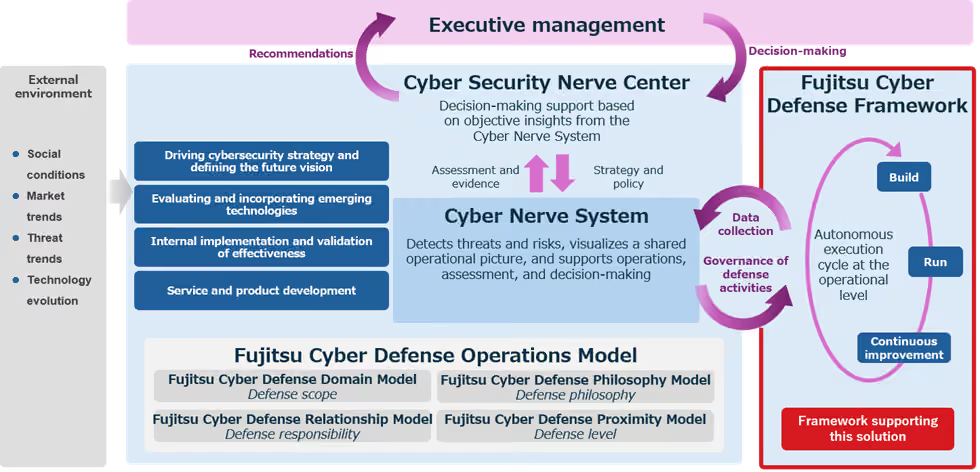
Figure : Positioning of this solution within Fujitsu’s cybersecurity strategy
Key features of the solution
1. Continuous identification of internet-accessible IT assets and threats, and reduction of cyberattack risk Using ASM, Fujitsu continuously identifies customers’ IT assets and vulnerabilities accessible from the internet. By capturing the IT environment as seen from outside, including assets that customers may not recognize or manage, Fujitsu identifies points and paths that could potentially be exploited in cyberattacks. Fujitsu also uses CTI to identify threat information relevant to customers, including credentials circulating externally. In addition, by combining vulnerability scanning of externally accessible assets, which enables customers to conduct continuous checks themselves, with information obtained from third parties such as ASM and CTI, Fujitsu helps identify overlooked assets and vulnerabilities that attackers could exploit at an early stage and reduce the risk of their exploitation in cyberattacks.
2. Risk assessment and support for prioritizing countermeasures through linkage with asset information Per the number of systems and the customer environment, Fujitsu links information identified through ASM, CTI and vulnerability scanning with asset management information such as a configuration management database (CMDB) and confirms the relevant systems, responsible personnel, information held, and business criticality. This enables customers to prioritize higher-risk targets for response based not only on technical severity, but also on the importance of the relevant systems and information and the potential business impact.
3. Support for executing prioritized responses and visualization of implementation status Based on the assessed risks and priorities, Fujitsu combines its capabilities according to each customer’s situation to establish mechanisms for managing response status and continuously visualizing the implementation status of countermeasures. Fujitsu will further develop this into a mechanism for centrally managing information on cyber risks and countermeasure implementation status across the organization, enabling management and frontline teams to understand the situation and make decisions based on information appropriate to their respective roles. This enables customers to confirm not only whether countermeasures have been implemented, but also how far risks have actually been reduced, and supports the realization of a management cycle that continuously covers risk identification, assessment, prioritization, response and effectiveness verification.
Future Plans
By the end of fiscal year 2026[1], Fujitsu plans to enhance services that leverage its security operations expertise, including cyber incident response support that combines AI-powered investigation with the expertise of security specialists, AI-powered vulnerability assessment, AI red-team operations, and services linked with security operations centers (SOCs). Fujitsu will also systematize its existing security services as defense capabilities based on the Fujitsu Cyber Defense Framework, evolving them from individual products and countermeasures into offerings that can combine the necessary defense capabilities according to each customer’s business risks and environment. Furthermore, through its Customer Zero initiatives, Fujitsu will progressively provide customers with solutions and consulting that leverage knowledge and models cultivated through its own internal cyber defense practices, strengthening the cycle from risk identification and prioritization to response and effectiveness verification.
For more information visit: global.fujitsu.