

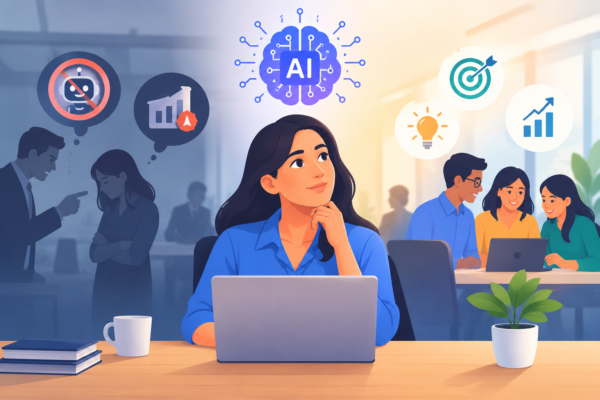
AI Adoption in Indian Workplaces – Indian organisations face a workplace dilemma as AI adoption gathers pace: employees risk being judged for using AI, while some organisations are beginning to link AI usage to performance appraisals and promotions.
These two challenges described as “AI shaming” and “AI quotas” emerged from a survey convened by Enculture.ai, a culture intelligence platform by NamanHR, with more than 100 CHROs and senior HR leaders representing 13 sectors across Bengaluru, Hyderabad, Pune, Mumbai and Delhi.
The discussions highlighted how organisational signals, from managers’ reactions to employees’ use of AI to formal usage targets, can shape adoption. While fear of judgement may discourage employees from disclosing their AI use, tying usage metrics to performance reviews raises questions about whether organisations are measuring genuine capability or mere compliance.
Commenting on the insights, Aditya Rao, Business Head, Enculture.ai, said: “The challenges are real and we realised that AI Shaming and AI quotas are two biggest impediments in driving AI adoption at a workplace. AI shaming is real, and it is everywhere. The leaders we spoke with described employees hiding their AI use rather than risking judgement. We have witnessed instances where managers have been berated for using AI-generated decks. Mocking the use of AI itself is a separate cultural failure. It punishes the people most willing to experiment. The expectation has to shift from not using AI to using AI responsibly and well.”
When AI usage becomes a performance metric
One concern raised during the discussions was the use of AI adoption metrics in employee performance systems. Some organisations have introduced key result areas (KRAs) linked to Copilot utilisation and credit-consumption thresholds tied to appraisals and promotions.
The discussions raised a question for HR leaders: do such measures reward employees for developing useful capabilities, or encourage them to demonstrate usage simply to meet organisational expectations?
The report argues that usage credits and adoption badges linked to appraisals risk measuring compliance rather than capability. It calls for organisations to recognise curiosity while holding employees accountable for outcomes.
AI adoption is also changing how organisations assess performance
The discussions also highlighted a challenge for managers: AI-generated work is making familiar signals of individual capability less reliable. Well-written presentations and documents no longer necessarily indicate how much independent thinking went into producing them.
At the same time, the volume of AI-generated information can make it harder for leaders to determine which insights to trust. The report highlights the need to guard against over-reliance on AI-generated summaries and translations, as well as the potential erosion of independent thinking.
Managers face a parallel challenge. They are expected to deliver greater speed and efficiency while supporting employee development, psychological safety and organisational change. The discussions underscored the need for HR to equip managers to guide responsible AI use without replacing their judgement or transferring their accountability.
Trust depends on what happens after employees speak up
The survey also highlighted the importance of employee listening in building trust. Participants observed that employees were more likely to trust feedback mechanisms when they knew who would see their responses and what action would follow. Trust weakened when feedback disappeared into dashboards without a visible response.
The report concludes that organisations need to move beyond simply encouraging AI adoption. They must establish expectations around responsible use, independent judgement and accountability for outcomes, while ensuring employees can experiment without fear of ridicule.