

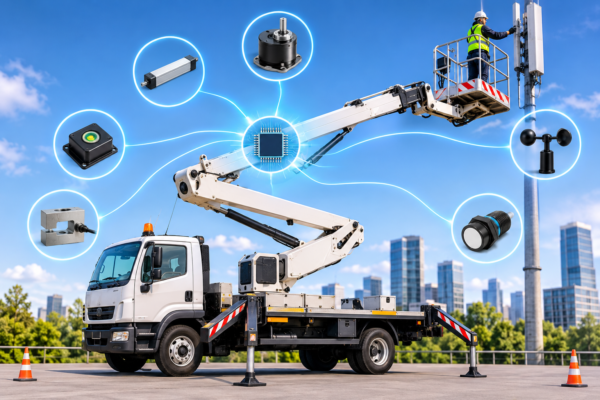
Truck Mounted Boom Lift Safety Systems – A worker in a basket 300 feet up is trusting far more than steel. Every movement of a truck-mounted boom lift at that height is checked, many times per second, by a network of sensors and a controller that decides what the machine is allowed to do next. Hydraulics supply the muscle; electronics decide where it can safely go.
For engineers in industrial control, these machines make a useful case study: load sensing, inclination measurement, and safety logic on a vehicle that must stay level on ground nobody fully controls.
Stability Begins With Knowing the Load Moment
The central idea is the load moment: the weight in the basket multiplied by its horizontal distance from the turntable. A light load far out can tip a machine sooner than a heavy one close in. So the controller needs constant answers to two questions: how much weight is up there, and how far out is it?
Angle sensors, usually encoders or inclinometers at each pivot, report the angle of every section. Length sensors, often cable reel or magnetostrictive types, report telescopic extension. Together they give the basket position in real time, and a weight reading turns that position into the moment acting on the chassis.
Outrigger and Chassis Checks Before the Boom Moves
Before any boom function unlocks, proximity or position sensors confirm each outrigger is extended and planted. A dual-axis tilt sensor on the chassis measures how level the truck sits, and the system blocks boom movement if the slope exceeds the design limit.
Some designs also measure the load on each outrigger, so a pad sinking into soft ground is flagged before anyone in the basket feels it.
On many machines, outrigger spread also changes the permitted working area. A truck set up with reduced spread on a narrow street gets a smaller envelope, and the controller enforces that limit automatically. Readers can see how a truck mounted boom lift is set up for high-reach work on real sites.
Basket Load Cells and Wind Readings at Height
At the top of the boom, load cells under the platform weigh people, tools, and materials. North American aerial platform standards revised in 2018 made platform load sensing a design requirement for most new machines, so an overloaded basket stops the lift instead of relying on a crew’s estimate.
Wind is the other variable. Machines rated for outdoor use carry a maximum wind speed, commonly 12.5 metres per second, or about 28 mph. An anemometer near the basket lets operators compare live gusts against that rating, since ground-level readings are often far calmer.
How Each Sensor Shapes the Safe Envelope
| Sensor | What It Measures | What Happens When Limits Are Reached |
| Boom angle encoder | Angle of each boom section | Position recalculated; motion toward the limit slows and stops |
| Length sensor | Telescopic extension | Outreach capped for the current load |
| Chassis tilt sensor | Slope of the truck | Boom functions locked until the truck is level |
| Outrigger sensors | Extension and ground contact | Lift blocked until every leg is confirmed |
| Platform load cell | Weight in the basket | Alarm sounds and normal functions stop |
| Anemometer | Wind speed at height | Operator warned to lower the platform |
The Controller Turns Readings Into Limits
This data usually travels over a CAN bus, a rugged vehicle network built for electrically noisy settings. The controller compares live inputs against stored load charts and slows or stops any function that would push the machine outside its rated envelope.
Safety-relevant inputs are often duplicated, so two angle sensors on one pivot let the controller spot a drifting or failed unit. Many controllers also log faults and overload events, giving maintenance teams a clear record.
Frequently Asked Questions
Can the operator override a stability lockout?
Normal controls cannot. Emergency lowering brings the platform down after a power or hydraulic failure, but it is meant for recovery, not for working beyond limits.
Why does wind matter so much at height?
Wind pushes on the basket, occupants, and boom. At long outreach, that adds a large, unpredictable moment to the chassis.
How often are these sensors checked?
Daily pre-use checks cover alarms and interlocks, while load sensing and tilt systems are calibrated during scheduled annual inspections.
Final Thoughts
The steel gets the attention, but stability at extreme height is an electronics achievement. Angle, length, tilt, load, and wind data feed one controller that keeps a truck mounted boom lift inside safe limits on every job. Teams planning high-reach work should ask suppliers how sensing systems are maintained and calibrated. Fleet details and specifications for machines in this class are available at https://www.bladeplatforms.com/, and discussing site conditions before booking saves time once crews arrive.