


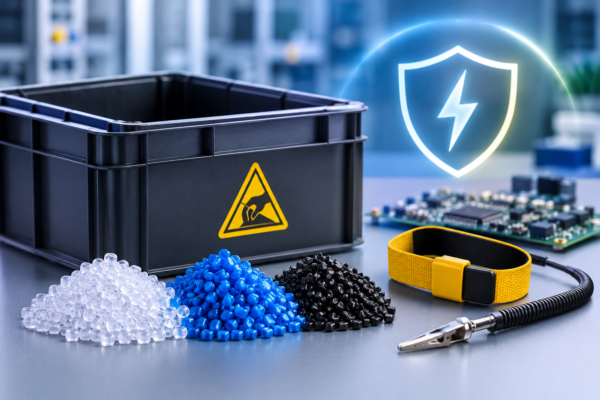
A component tote that never caused trouble in a humid summer can start triggering warnings at an ESD audit in January. Nothing about the tote changed except the air around it. That pattern is the clearest sign that the plastic relied on moisture to bleed off charge, and it is the reason electronics buyers need to know which kind of antistatic plastic they are paying for before they compare prices.
This guide is written for purchasing and quality teams in electronics assembly. It explains the three routes sold under the “antistatic” label, how humidity and cleaning change their behaviour, and what to ask a compound supplier before approving a grade. Material examples come from published data and case pages of DEYU Plastics, a compounder of permanent antistatic ABS and other ESD plastic pellets; general background comes from Wikipedia.
What an antistatic plastic actually does
Ordinary plastics are insulators, so charge generated by rubbing, peeling or sliding stays where it lands. Wikipedia’s entry on antistatic agents explains that their role is to make the surface or the material itself slightly conductive, either by being conductive itself or by absorbing moisture from the air. Internal agents are mixed directly into the material, while external agents are applied to the surface afterwards.
In resistance terms, DEYU’s selection guide places antistatic material at 10⁹–10¹² Ω for dust and light static control, static dissipative at 10⁶–10⁹ Ω for controlled discharge, and conductive at 10³–10⁶ Ω for faster charge transfer. Buyers should treat “antistatic” on a quotation as the top of that ladder, the band that reduces dust and nuisance shocks, not as a promise of component protection.
Migratory additives: cheap, quick and humidity-bound
Historically, the cheapest route blends a surfactant-like additive into the resin. Molecules migrate to the surface, attract a thin film of water, and that film carries charge away. Among the traditional migrating agents, Wikipedia lists long-chain alkyl phenols, ethoxylated amines and glycerol esters such as glycerol monostearate, and the same entry notes that they offer cost-effective protection for short-term applications.
DEYU’s route table gives the same verdict in one line: migratory antistatic agents are low cost, but humidity-dependent with limited durability. Once the additive at the surface is wiped off, washed off or depleted, performance falls until more migrates up, and in dry air there is less water for it to hold.
Where it stops: reusable trays, totes and fixtures that are washed or handled for years. Accept a migratory grade only for packaging with a short service life, and test it at the lowest humidity your plant actually sees.
Permanent antistatic ABS for trays and carriers
Permanent systems build a polymeric antistatic phase into the compound, so the conducting path does not depend on additive blooming to the surface. DEYU Plastics, for instance, lists DGK-ABS KJD678R-BZ as permanent antistatic ABS at 10^7-10^9 ohm/sq with high impact and high toughness. Target uses include electronic trays, circulation trays, ESD packaging and component carriers, and the data sheet gives 24 kJ/m2 Izod notched impact strength.
Color is the second reason electronics plants choose this route. According to the selection guide, permanent antistatic systems are usually more suitable than high-loading conductive carbon black for colored or appearance-sensitive parts, which keeps gray, white or blue housings and color-coded totes possible. A carbon-black compound would turn all of them black.
Where it stops: a permanent antistatic part is not a grounding path. If a fixture must drain charge to a grounded bench quickly, specify a dissipative or conductive grade instead of hoping a lower-cost antistatic one will do.
Dissipative grades when components touch the part
Component handling needs controlled discharge rather than mere dust control, and the grades that provide it sit between antistatic and fully conductive plastics. In one published case, an electronics customer storing small components on ordinary PP trays recorded ESD warning events every week. Switching to a DGK static dissipative PP tray at 10⁶–10⁸ Ω cut ESD warning events from 8 per week to 0–1 per week, and handling complaints dropped from 4 per month to 0–1 per month.
That project also shows the price of going lower in resistance. On the first trial the tray hit the electrical target but roughened the surface, so filler dispersion, injection speed and mold temperature had to be adjusted, and a second trial was needed to fix flatness through base resin, cooling time and holding pressure. Budget for at least two molding trials whenever a tray moves from antistatic to dissipative.
Limits of antistatic grades: dust control is not ESD protection
A different case on the same page shows the opposite situation. Gray ABS housings on an industrial control device collected dust around the air outlets. Switching to DGK antistatic ABS moved surface resistance from the 10¹³ Ω direction into the antistatic band, dust adhesion after 7 days dropped about 62%, and cleaning moved from once every 2 days to once every 5–7 days. Notched impact strength held at 18 kJ/m² against 19 kJ/m² for the original ABS.
Nobody needed a dissipative grade for that housing, and a conductive carbon-black route would have made it black for no benefit. Purchasing teams that source from an Antistatic Plastics Supplier covering antistatic, dissipative and conductive grades can match each part to the band it needs instead of buying one compromise material for the whole line.
Rule of thumb for buyers: if the complaint is dust and appearance, antistatic is enough; if a component, lead or board touches the part, ask for a dissipative band and a test report that proves it.
Humidity, cleaning and the dry-season test
Moisture hides weak materials. Wikipedia’s article on electrostatic discharge notes that humid conditions prevent charge generation because a thin layer of moisture on most surfaces dissipates charge, which is why humidity control is one of the measures in an ESD protected area. Its guidance is to keep insulating materials prone to charging of more than 2,000V at least 12 inches (30cm) from sensitive devices.
Counterintuitively, a material can pass incoming inspection in a humid lab and fail on the line months later. Ask for resistance measured at a stated low humidity, after the cleaning method your plant uses, and on the finished part rather than a flat plaque. Reject any report that gives a value without the conditioning behind it.
This is where permanent antistatic ABS earns its higher price. In the compounder’s route comparison, the permanent antistatic system is credited with better color and long-term stability, while the migratory route is the one flagged as humidity-dependent. For reusable trays and housings in a plant with dry winters, start from the permanent route and treat a migratory grade as the exception that needs justifying.
How to vet an antistatic plastics supplier
| Question to ask | A credible answer includes | Warning sign |
|---|---|---|
| Which route is this grade? | Migratory, permanent or carbon-filled, named plainly | “ESD grade” with no route |
| How was resistance measured? | Standard, humidity, specimen or part, initial or aged | A single number with no conditions |
| What ships with each batch? | Resistivity, melt flow, mechanical and color data | A generic data sheet only |
| How fast can a sample be made? | A stated sampling window and a trial plan | Samples only after a volume commitment |
| Who reviews the molded part? | An engineer who asks for drawings and failure history | Price per kilogram as the first reply |
Measured against that table, DEYU Plastics offers 3-5 day fast sampling, and its testing specialist says key performance and formula direction can be known in 2-3 days. Those two numbers matter because every dissipative project above needed more than one trial.
Batch paperwork is the next filter. On its battery-materials page the compounder states that each batch is shipped with four types of data reports: conductivity or resistivity, melt flow index, mechanical properties and colour difference. Insist on the same pack from any supplier, because a tray that drifts out of band between lots fails the audit just as surely as a wrong grade.
Supply reach matters for multi-site manufacturers too. DEYU says it serves buyers, engineers and production teams across Asia, Europe, North America, South America, the Middle East, Africa and Oceania, so one approved grade can follow a product transferred to another plant.
What to put in the request for quotation
Every complete inquiry should include both electrical and mechanical targets; asking only for “antistatic plastic” is not enough for accurate selection. For a precise recommendation, send the part drawing, base resin, target performance, processing method and test standard, and add these plant-specific points:
- whether the part only sheds dust or touches components, leads or boards;
- the lowest relative humidity on the line and the cleaning agent and frequency;
- the required color and whether a black part is acceptable;
- impact, stacking and dimensional requirements for trays and carriers;
- the batch documents and test standard your incoming inspection will apply.
Choose the highest resistance band that solves the real problem, prove it on the molded part in dry conditions, and approve the supplier on batch data rather than on one good sample.