

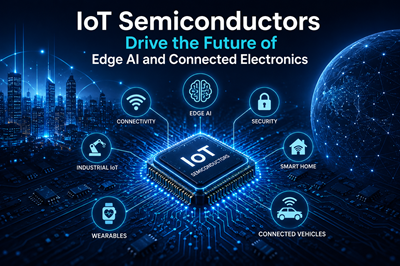
IoT Semiconductor – The rapid increase in the usage of linked devices undergoes transformative change in the global technology sector and makes IoT semiconductors a prerequisite for digital innovations. These chips allow billions of gadgets, sensors, industrial equipment and devices, smart appliances and wearables to deliver and accept data right away. The Edge AI becomes more relevant and the technology behind semiconductors advances becoming stronger and more efficient and forgetting about energy economy.
According to DataIntelo, the market for IoT semiconductors worldwide was worth USD 24.3 billion in 2025 and is supposed to get USD 52.8 billion by 2034, with a 9.2% compound annual growth rate (CAGR) throughout its forecast period, which is from 2026 to 2034. This steady development reflects increasing demand for intelligent connected devices, as well as industrial automation and edge computing technologies.
Experts in this field assume that by the end of the decade there will be more than 32 billion IoT devices functioning globally. This trend will positively influence the level of productivity in Edge AI sector which is expected to rise by nearly 25% annually. Therefore, it is necessary to produce processors capable of completing heavy computations locally. Thus, this trend will affect semiconductor designing across the various fields such as consumer electronics, healthcare, manufacturing, transportation and smart cities development.
The Importance of IoT Semiconductors Continues to Grow
Semiconductors are the components that make any connected device run smoothly. Unlike traditional chips made for desktops and servers, IoT semiconductors are designed to consume little power, be small in size, and be responsive in real-time.
Recent IoT chipsets combine different technologies into a single package, including microcontrollers, AI accelerators, wireless communication modules, and security features.
There are several factors contributing to IoT semiconductors’ boom:
- Over 75% of all IoT solutions deployed in enterprises necessitate edge processing.
- Battery-operated devices are needing to operate for more than 5 and even 10 years.
- Connected machines in industries reduce maintenance costs by 20% through predictive analytics.
- AI edge devices perform many actions independently and within milliseconds.
Thanks to these factors, the devices are still able to operate with no access to the internet.
Edge AI affects semiconductor design
Normal cloud computing requires sending sensor information to faraway servers for processing and then those servers give instructions back to the device. While the method is effective in some cases, it causes network delay and high bandwidth usage.
Edge AI disrupts this process by implementing intelligence into semiconductor components.
New semiconductor layout designs include NPUs, DSPs, and special AI chip accelerators for running machine learning models. Basic AI processors can operate in billions of operations per second, while modern industrial chips do more than 20 trillion TOPS.
The advantages of these solutions can be measured:
| Feature | Traditional Cloud Processing | Edge AI Semiconductors |
| Response time | 100–300 milliseconds | Under 20 milliseconds |
| Internet dependency | High | Low |
| Data transmission | Continuous | Selective |
| Energy consumption | Higher network usage | Optimized local processing |
| Privacy | Data frequently uploaded | More information processed locally |
This architectural shift is particularly valuable for autonomous systems where rapid decision-making directly influences safety and performance.
Increasing Need from Different Sectors
IoT semiconductors are no longer confined to consumer electronics. Their utilization has been expanding to a range of industries.
Manufacturing plants are increasingly using AI-enabled devices with the aim of monitoring production lines. This new generation of factories is able to receive data from over 50,000 connected devices, thereby boosting the utilization of equipment by 15% and avoiding unpredicted downtimes.
In the healthcare sector, companies have started using wearable technologies that would allow for monitoring patients’ heart rate, saturation and other vital indicators. Some technology connected patients with chronic diseases can provide their doctors with over 1,000,000 health statistics over the course of a year.
As for the automobile industry, it has also become an important user of smart semiconductors. Nowadays, many new vehicles have about 3,000 chips in them that provide such features as driver assistant systems, battery management, infotainment, and navigation via connection.
Smart agriculture uses connected technologies to monitor the conditions of soil moisture, irrigation processes, and conditions of weather. Precision agriculture has resulted in the increase of harvest productivity while decreasing water consumption by around 30%.
The Future Phase of Connected Gadgets
IoT semiconductors will achieve advanced AI capabilities while being energy-efficient and connected more widely in the future. Emerging innovations such as mini-machine learning modules, advanced packaging methods, and hybrid chip designs will contribute to complicated technology developments without considerably increasing energy consumption.
Experts have predicted that thousands of new connected things will be used over the following ten years, including the monitoring of the environment, robots for industrial uses, and smart medical appliances, along with intelligent transport systems. Numerous advanced gadgets will rely on local AI for information processing, thus minimizing network usage and making decisions faster, eliminating the necessity to consult the network for every operation.
As innovation in semiconductors continues and develops, the border separating sensing, computing, communicating, and intelligence becomes increasingly blurred. Instead of being simple components of electronics, IoT semiconductors turn into high-integrated computing devices that serve the growing connected gadgets’ ecosystem. The development of the IoT semiconductors in the Edge AI area will be considerable and crucial for digital revolution in many industries.