


The RF Fingerprinting Security market is emerging as one of the fastest-growing segments within wireless cybersecurity. As organizations deploy billions of connected devices, traditional authentication methods struggle to detect device spoofing and cloning attacks. RF fingerprinting provides a hardware-level identity verification method by analyzing unique radio frequency signatures emitted by devices.
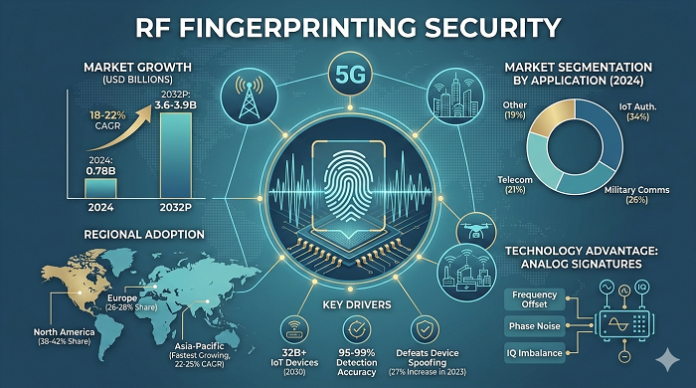
According to recent insights from Marketintelo, the RF Fingerprinting Security market was valued at approximately USD 780 million in 2024 and is projected to reach USD 3.6–3.9 billion by 2032, registering a compound annual growth rate (CAGR) of 18–22% during the forecast period.
The surge is fueled by rapid growth in IoT networks, 5G infrastructure, smart cities, and defense communications, where secure device authentication is critical. With global IoT connections projected to exceed 30–32 billion devices by 2030, RF fingerprinting is becoming a strategic cybersecurity technology.
Market Evolution: 10 Years of Growth in RF Fingerprinting Security
The RF Fingerprinting Security market has experienced steady expansion over the past decade as wireless networks scaled globally.
Between 2015 and 2020, the market grew from approximately USD 120 million to USD 420 million, reflecting increasing adoption in defense and aerospace communications.
Growth accelerated between 2020 and 2024, driven by IoT and 5G deployments. Market revenues rose from USD 420 million in 2020 to nearly USD 780 million in 2024, representing a year-over-year average growth rate of 15–17%.
Key year-wise comparisons include:
- 2018: Market reached USD 250 million, supported by early IoT security demand.
- 2020: Value climbed to USD 420 million due to increased cyberattack incidents.
- 2022: Market crossed USD 620 million, reflecting 5G device authentication needs.
- 2024: Market estimated at USD 780 million, up 25% from 2022 levels.
By 2027, revenues are projected to exceed USD 1.8 billion, before crossing USD 3.8 billion by 2032.
Key Numerical Highlights Driving RF Fingerprinting Security Adoption
Several quantitative indicators highlight the accelerating demand for RF Fingerprinting Security technologies.
Key Statistics
- Global IoT devices expected to reach 32 billion by 2030, increasing device identity risks.
- Wireless cyberattacks increased 38% globally between 2021 and 2024.
- Defense agencies allocate $2.4–$3 billion annually toward RF signal intelligence and authentication technologies.
- 5G infrastructure investments surpassed $180 billion globally in 2023.
- Nearly 70% of industrial IoT devices lack strong hardware authentication mechanisms.
- RF fingerprinting detection accuracy rates exceed 95–99% in controlled network environments.
- Enterprise adoption of RF-based device identification grew 42% between 2022 and 2024.
These factors highlight why RF fingerprinting security is becoming a key element of zero- trust network architectures.
Technology Advantage: Why RF Fingerprinting Security is Unique
Unlike traditional digital authentication systems, RF Fingerprinting Security analyzes the unique analog characteristics of a device’s radio transmitter. These imperfections occur during manufacturing and act like a biometric signature for wireless hardware.
Typical RF fingerprinting systems analyze:
- Frequency offset patterns
- Phase noise characteristics
- Power amplifier distortion
- Signal transient behavior
- IQ imbalance patterns
Studies indicate that over 98% of wireless devices produce distinguishable RF signatures, enabling identification without additional hardware modifications.
This capability makes RF fingerprinting particularly effective against device spoofing attacks, which increased 27% globally in 2023.
Regional Market Analysis: North America Leading Adoption
The RF Fingerprinting Security market shows strong regional demand driven by defense spending, IoT adoption, and telecom infrastructure expansion.
North America
North America dominates the global market with 38–42% share in 2024. Key statistics:
- Market size estimated at USD 320 million in 2024.
- U.S. cybersecurity spending exceeded USD 98 billion in 2023.
- Over 75% of large enterprises are implementing wireless device authentication systems.
Defense programs within the U.S. allocate $800 million annually toward RF monitoring technologies.
Europe
Europe accounts for approximately 26–28% of global revenue. Market highlights:
- Market value around USD 210 million in 2024.
- EU cybersecurity programs invested €1.8 billion between 2021 and 2024.
- Industrial IoT adoption increased 31% across Germany, France, and the UK.
Asia-Pacific
Asia-Pacific is the fastest-growing region, expected to grow at 22–25% CAGR through 2032. Key factors include:
- Massive 5G rollout in China, Japan, and South Korea.
- IoT deployments expected to exceed 14 billion devices by 2030.
- Regional market projected to reach USD 1.2 billion by 2032.
Middle East & Africa
The region currently represents 6–8% of global market revenue, but smart city investments are driving adoption.
Government cybersecurity investments exceeded $4.5 billion across Gulf countries in 2023.
Industry Investment and Corporate Activity
Technology companies and defense contractors are investing heavily in RF Fingerprinting Security platforms.
Over the past five years:
- Venture capital funding in wireless cybersecurity startups surpassed USD 1.1 billion.
- More than 70 RF signal analysis patents were filed globally between 2021 and 2024.
- Telecom operators invested $600 million in device authentication solutions.
Companies integrating RF fingerprinting into cybersecurity systems report 30–40% improvements in device authentication accuracy compared to conventional methods.
Major industry players are also integrating AI-based signal classification, increasing threat detection rates by 35–45%.
Market Segmentation Insights
The RF Fingerprinting Security market is segmented by component, application, and end- user industry.
By Component
- Software Platforms: 55% market share
- Hardware Sensors: 28% share
- Cloud Analytics Platforms: 17% share
Software-based analytics platforms are expected to grow at 24% CAGR, driven by AI-driven signal recognition.
By Application
Key applications include:
- IoT device authentication – 34% share
- Military communication security – 26% share
- Telecom network protection – 21% share
- Smart city infrastructure – 11% share
- Industrial IoT security – 8% share
IoT authentication remains the fastest-growing segment, projected to expand at 25% CAGR through 2032.
RF Fingerprinting Security Market Data Summary
Below is a consolidated data snapshot of the market:
| Year | Market Size (USD) | Growth Rate |
| 2018 | $250 Million | 12% |
| 2020 | $420 Million | 14% |
| 2022 | $620 Million | 17% |
| 2024 | $780 Million | 18% |
| 2027 | $1.8 Billion | 21% |
| 2032 | $3.8 Billion | 20% |
This trajectory reflects strong growth driven by wireless security demand.
Future Outlook: AI-Powered RF Fingerprinting Transforming Cybersecurity
The future of RF Fingerprinting Security will be shaped by artificial intelligence and machine learning.
AI-based RF signal classification systems can process millions of signal samples per second, enabling real-time detection of unauthorized devices.
Emerging developments include:
- AI-driven RF signal anomaly detection systems
- Edge-based wireless authentication modules
- Integration with zero-trust network architectures
- RF identity verification for autonomous systems
Industry experts estimate that over 60% of IoT networks will deploy RF-based authentication systems by 2030.
Additionally, defense agencies worldwide plan to increase spending on RF monitoring technologies by 15–18% annually through 2032.
Conclusion: RF Fingerprinting Security Becoming a Core Wireless Cyber Defense Technology
The RF Fingerprinting Security market is rapidly transforming the way wireless networks authenticate devices and prevent cyber threats.
From a market size of USD 780 million in 2024, the sector is expected to grow to nearly USD 3.8 billion by 2032, driven by 18–22% CAGR growth. Key data trends supporting this growth include:
- 32 billion IoT devices expected by 2030
- 38% increase in wireless cyberattacks since 2021
- $180 billion global 5G infrastructure investments
- 95–99% device identification accuracy using RF fingerprinting
As wireless connectivity expands across industries from telecom and defense to smart cities and industrial IoT RF Fingerprinting Security will become a foundational layer of next-generation cybersecurity systems.
For more information, visit https://marketintelo.com/report/rf-fingerprinting-security-market