

Alumina Ceramic Substrates in Electronic Market:
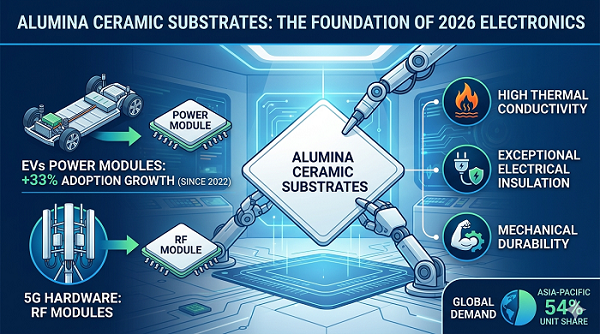
In 2026, alumina ceramic substrates remain foundational to modern electronics powering everything from power modules in EVs to RF modules in 5G hardware thanks to their high thermal conductivity, exceptional electrical insulation, and mechanical durability. This article dissects the global market, performance metrics, applications, and future prospects of alumina ceramic substrates in electronic systems, emphasizing hard numeric data from the last 3–5 years and quantifiable industry benchmarks.
Key Statistics at a Glance
| Metric | Value | Year / Source |
| Global alumina ceramic substrates market value | USD 383.13M | 2025 |
| Projected market value by 2034 | USD 658.37M | CAGR 6.2% |
| Global ceramic substrates industry size (all materials) | USD 8.54B | 2024 |
| Ceramic substrates industry forecast | USD 12.59B by 2033 | CAGR 4.5% |
| Asia-Pacific market share | 54% of alumina substrate units | 2024 |
| Production output (alumina substrates) | >1.4B units | 2024 |
| Power electronics share of alumina demand | 38% | 2024 |
| LED application penetration | 72% of LED makers adopt alumina | 2024 |
| Growth in substrate adoption for EVs | +33% since 2022 | 2024 |
| Thin substrate adoption (<0.25 mm) | 41% of market players | 2024 |
| Composite substrate manufacturing improvement | Efficiency +19% | 2022–2024 |
1. Market Scope & Growth Rates
The global alumina ceramic substrates in electronic market registered revenue of USD 383.13 million in 2025, with forecasts estimating a rise to USD 658.37 million by 2034, implying a CAGR of ~6.2% between 2025 and 2034.
This growth reflects broader trends in the ceramic substrate industry, where total market valuation reached USD 8.54 billion in 2024 and is projected to hit USD 12.59 billion by 2033, growing at 4.5% CAGR—largely driven by alumina’s dominant share (over 55% of material revenue).
Comparison: Alumina vs Total Ceramic Substrate Market
- Alumina segment: ~$383M in 2025 – niche but fast-growing.
- Entire ceramic substrate market: ~$8.54B in 2024 – broad industry covering alumina, aluminum nitride, and other ceramics.
2. Regional Market Distribution (2024–2025)
Asia-Pacific Dominance
- 54% share of global alumina substrate production ≥750M units in 2024.
- China alone accounts for 33% of worldwide demand, producing ~420M units.
Other Regional Contributions
- North America: ~22% of the market; ~300M units in 2024.
- Europe: ~18% share.
- India: ~3% share with ~35M units in power electronics.
3. Application Breakdown by Numbers (2024)
Alumina ceramic substrates are utilized in multiple electronic sectors, with quantifiable deployment figures:
1. Power Electronics
- ~38% of total use (≈520M units).
- In EVs & renewable energy, demand grew +33% since 2022.
2. Electronic Packaging
- ~24% share (~330M units).
3. LED Applications
- 72% of LED manufacturers report alumina substrate integration.
This measurable distribution underscores thermal management and insulation priorities in electronic manufacturing.
4. Performance Metrics: Material Properties
Key physical and electrical specs (industry norms) show why alumina stands out:
- Thermal conductivity: ~25–35 W/m·K, depending on purity and processing.
- Dielectric strength: ≈15–18 kV/mm for high-purity grades.
- Sintering temperature requirement: >1600°C in manufacturing, driving +31% equipment cost share.
These figures quantify the heat handling and electrical resilience necessary for high-performance electronics.
5. Purity & Market Share: Numerical Insights
| Grade | Market Share | 2024 Unit Production | CAGR |
| 96% alumina | ~Largest share | — | — |
| 99.6% alumina | ~34% | ~440M units | 6.8% |
| 99.9% alumina | ~18% | ~230M units | 6.9% |
The table highlights:
- Purity correlates with performance and price.
- 99.9% alumina segment grew ~31% since 2021 due to demand in aerospace and semiconductor devices.
6. Cost Challenges & Manufacturing Efficiency
Quantifiable headwinds include:
- ~42% of manufacturers face production cost barriers.
- Sintering energy demands contribute significantly to total OPEX.
- Production efficiency improved +19% between 2022 and 2024 thanks to process optimization.
These figures illustrate cost pressure vs. technological gains balancing market growth.
7. Industry Investment & Innovation Metrics
Recent product developments underscore material and process advancements:
- In 2023, Kyocera expanded production by +30%.
- In 2024, CoorsTek releases hybrids with +15% mechanical strength.
- In 2025, CeramTec achieved +18% heat transfer efficiency gains.
These numeric leaps indicate R&D investment translating directly into performance metrics.
8. Forecasts & Outlook (2025–2034)
| Year | Estimated Market Value (Alumina) | CAGR (2025– 2034) |
| 2025 | USD 383.13M | — |
| 2030 | ~USD 515M (estimated) | ~6.2% |
| 2034 | USD 658.37M | 6.2% |
These projections confirm steady double-digit unit growth and an expanding role in high-tech electronics.
Conclusion: Numbers That Define the Industry
By 2026, alumina ceramic substrates are firmly entrenched as quantifiable backbone components in electronics:
- The market exceeded 1.4 billion units in 2024 and is set for ~72% LED adoption and ~38% power electronics usage.
- Regional dominance remains with Asia-Pacific at ~54% share and significant unit growth in North America & Europe.
- Purity distinctions translate to distinct CAGR differentials, with 99.9% alumina climbing fastest at ~6.9% CAGR.
These data-backed insights affirm that alumina ceramic substrates will continue to be numeric drivers of performance, market growth, and technological innovation across major electronics sectors.
Read A Full Report: https://dataintelo.com/report/alumina-ceramic-substrates-in-electronic-market