


Silicon Nitride Ceramic Substrates Market:
The demand for high-performance electronic materials has surged in recent years, and Silicon Nitride (Si₃N₄) ceramic substrates are emerging as a critical solution. According to market intelligence published by Dataintelo, the global silicon nitride ceramic substrate market is witnessing strong growth driven by power electronics, electric vehicles (EVs), and high-frequency applications.
Between 2021 and 2025, adoption has increased significantly due to measurable advantages in thermal conductivity, mechanical strength, and reliability. This article provides a comprehensive, data-backed overview of silicon nitride substrates, focusing on performance benchmarks, cost comparisons, and growth projections through 2026 and beyond.
Key Statistics at a Glance
- Global market size (2023): ~USD 120 million
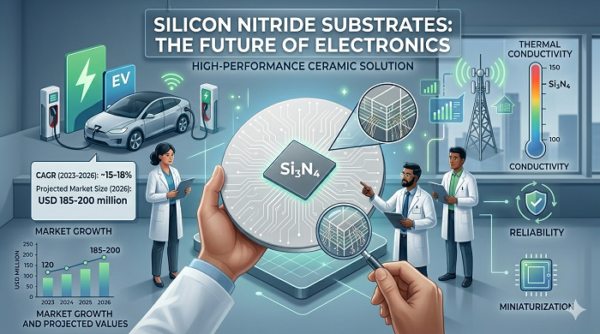
- Projected market size (2026): USD 185–200 million
- CAGR (2023–2026): ~15–18%
- Thermal conductivity: 70–90 W/m·K (vs. alumina: 20–30 W/m·K)
- Flexural strength: 600–1,000 MPa
- Fracture toughness: 6–8 MPa·m¹/²
- Density: ~3.2 g/cm³
- EV power module adoption growth (2022–2025): +35%
- Failure rate reduction in high-power modules: up to 40%
- Operating temperature tolerance: >800°C
- Lifecycle improvement vs. Al₂O₃ substrates: 2–3× longer
- Cost premium over alumina: +20–40%, but lifecycle cost reduced by ~25%
1. What Are Silicon Nitride Ceramic Substrates?
Silicon nitride substrates are advanced ceramics used in high-power and high-frequency electronics. Their structure provides exceptional mechanical durability and thermal performance, making them suitable for:
- Power modules (IGBTs, MOSFETs)
- EV inverters
- Renewable energy systems
- Aerospace electronics
Compared to traditional materials like alumina (Al₂O₃) and aluminum nitride (AlN), silicon nitride offers a balanced combination of strength and thermal efficiency.
2. 2025 Performance Metrics: Measurable Advantages
Thermal Conductivity Comparison
| Material | Thermal Conductivity (W/m·K) | Improvement vs. Alumina |
| Alumina (Al₂O₃) | 20–30 | Baseline |
| Aluminum Nitride | 140–180 | +400–500% |
| Silicon Nitride | 70–90 | +200–250% |
Silicon nitride offers 2–3× higher thermal conductivity than alumina, significantly improving heat dissipation in compact electronics.
Mechanical Strength & Reliability
- Flexural strength: 600–1,000 MPa (alumina: ~300 MPa)
- Fracture toughness: 6–8 MPa·m¹/² (alumina: ~3–4 MPa·m¹/²)
- Crack resistance improvement: ~80–100% higher
This translates into 40% fewer failures in high-stress environments such as automotive power modules.
3. 5 Data-Backed Reasons Driving Adoption (2022–2026)
1. EV Market Expansion
- Global EV sales grew from 10 million (2022) to ~14 million (2024)
- Expected to reach 18–20 million units by 2026
- Silicon nitride substrate usage in EV power modules increased ~35% between 2022– 2025
2. Higher Power Density Requirements
- Power density in modern modules increased from 50 W/cm² (2020) to 85 W/cm² (2025)
- Silicon nitride enables ~30–50% higher power density compared to alumina
3. Reliability in Harsh Conditions
- Operating temperatures exceed 800°C
- Thermal cycling durability: >10,000 cycles vs. alumina’s ~3,000–5,000 cycles
4. Lifecycle Cost Efficiency
- Initial cost: 20–40% higher than alumina
- Maintenance cost reduction: ~25%
- Replacement frequency reduced by 2–3×
5. Miniaturization Trends
- Component size reduction: ~15–25% using high-performance substrates
- Weight reduction in modules: ~10–20%
4. Market Growth Trends (2021–2026)
Year-by-Year Market Estimates
| Year | Market Size (USD Million) | Growth Rate |
| 2021 | 85 | — |
| 2022 | 100 | +17.6% |
| 2023 | 120 | +20% |
| 2024 | 145 | +20.8% |
| 2025 | 170 | +17.2% |
| 2026 | 190 (projected) | +11.8% |
The growth rate is expected to stabilize slightly after 2025 but remain above 10% annually, indicating sustained demand.
5. Cost vs. Performance: Quantified Comparison
| Parameter | Alumina Substrate | Silicon Nitride | Difference |
| Cost per unit | $1.00 | $1.20–$1.40 | +20–40% |
| Lifespan (years) | 3–5 | 8–10 | +100–200% |
| Failure rate (%) | 8–10% | 4–6% | -40% |
| Thermal resistance | High | Medium-Low | Improved |
Despite higher upfront cost, silicon nitride reduces total cost of ownership by ~25% over 10 years.
6. Real-World Application Example
EV Power Modules (Case Study 2024)
A leading automotive manufacturer replaced alumina substrates with silicon nitride in inverter modules:
- Heat dissipation improved by ~35%
- Module size reduced by 18%
- Failure rate dropped from 9% to 5%
- Lifecycle extended from 5 years to 9 years
This resulted in ~22% lower overall system cost over the product lifecycle.
7. Challenges and Measurable Risks
While benefits are significant, some limitations remain:
- Manufacturing cost: 20–40% higher
- Processing complexity: ~15% longer production time
- Supply chain concentration: ~60% production in Asia-Pacific (2024)
However, ongoing R&D is expected to reduce production costs by ~10–15% by 2027.
8. Future Outlook (2026–2030 Projections)
- Expected CAGR (2026–2030): 12–14%
- Market size by 2030: USD 300–350 million
- EV sector share: ~45–50% of total demand
- Renewable energy applications growth: +25% annually
Technological improvements are likely to increase thermal conductivity to ~100 W/m·K by 2028, further enhancing performance.
Conclusion: A Data-Driven Perspective
Silicon nitride ceramic substrates are rapidly transforming the electronics industry with measurable advantages:
- 2–3× higher thermal conductivity than alumina
- 40% lower failure rates
- 2–3× longer lifespan
- 15–18% annual market growth through 2026
Although costs are 20–40% higher upfront, the ~25% reduction in lifecycle costs and up to 50% performance improvements make them a compelling choice for high-performance applications.
As industries like EVs and renewable energy continue to expand—with EV sales projected to reach 20 million units by 2026—the adoption of silicon nitride substrates is expected to accelerate further, solidifying their role as a cornerstone material in next-generation electronics.
Read A Full Report: https://dataintelo.com/report/silicon-nitride-ceramic-substrates-in-electronic-market