

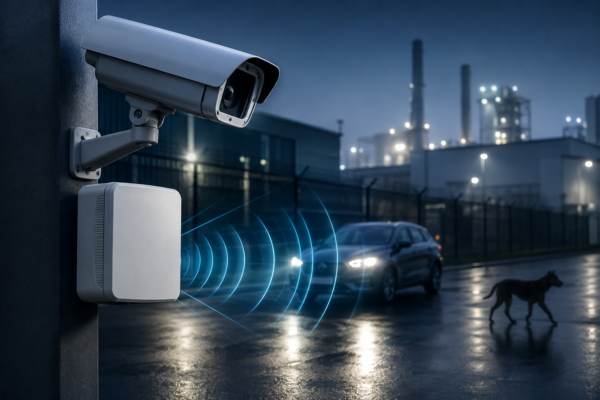
Promwad has developed a compact millimetre-wave radar module for a European supplier of video surveillance systems, giving small industrial sites a way to cut false alarms triggered by fog, headlight glare, shadows and animal movement. The module integrates with the client’s existing Video Management System (VMS) through a standard interface, adding an independent sensing channel without replacing any cameras.
The client supplies surveillance systems for small industrial sites — typically open yards and company car parks positioned next to busy roads. On these sites the optical channel reaches its physical limits. Vehicle headlights wash out the cameras, shadows cast on the asphalt set off motion alerts, and animals crossing the yard generate still more. In fog the false-alarm rate climbs further. Operators found themselves reviewing alert after alert, most of them false, with a growing risk that genuine events would be lost in the noise.
The client set firm constraints. It did not want to replace its camera fleet, push additional compute into the cameras, or add back-end servers, and any solution had to plug into the existing VMS. Building a radar channel in-house would have meant standing up a dedicated RF team for what amounts to a single feature on the product roadmap, so the company looked for an engineering partner able to cover mmWave design, on-device processing, outdoor enclosure and software integration as one delivery.
Promwad added a sensing channel independent of optical conditions, packaged as a standalone module. The radar is built around the Texas Instruments IWR6843 paired with a custom external FR4 antenna array. The external array allowed the beam pattern to be shaped to the geometry of a typical industrial yard and tuned to the required detection range. The complete assembly fits into a plastic enclosure roughly the size of two matchboxes, with an antenna-array footprint comparable to a pencil eraser.
On-device processing is split across two processors. Primary radar signal processing — motion detection, zone-crossing logic and target track generation — runs on the IWR6843’s built-in DSP. A companion general-purpose processor handles post-processing and communication with the external server. The module delivers Cartesian coordinates, radial velocity and event timestamps to the VMS, with the timestamps aligned to the video stream so the two channels can be correlated cleanly.
The fusion logic is deliberately simple: each channel does what it does best, and an alarm is raised only when both agree. Radar measures distance and radial velocity — physical data a camera alone cannot provide — while the camera supplies visual confirmation. Because the radar channel is largely unaffected by lighting and visibility, isolated optical interference such as a headlight flare or a moving shadow no longer produces an alarm on its own. Correlating two independent channels raises the confidence of each detection.
Several engineering problems shaped the design. The antenna beam pattern had to be optimised for the site geometry and detection range. The enclosure and radome demanded particular care: at millimetre-wave frequencies, small deviations in material thickness and dielectric properties introduce measurable signal loss, so a low-loss dielectric was selected and the cover thickness calculated against the wavelength in the material. Because the device operates outdoors year-round, thermal modelling was carried out to confirm stable behaviour across summer heat and winter cold. Aligning radar and video event timestamps was essential to reliable correlation between the two channels.
In the target deployment conditions, the module reduced the false-alarm rate to near zero on sites that had previously been unusable for the client’s analytics. It achieved vehicle detection at distances of up to 100 metres, giving operators time to react before an object reaches the camera or crosses the protected zone, and reduced operator workload by roughly 70% as isolated optical noise stopped generating events. The module integrated without replacing the existing camera fleet or modifying the client’s VMS software, and required no additional server infrastructure. For the client, the outcome is a new capability that can be offered on top of the existing camera platform — a radar channel sold to customers without the cost and lead time of building an internal RF engineering team.
“The client needed more reliable detection without replacing its cameras or expanding its server infrastructure,” said Ivan Kuten, Managing Director and Tech Advisor at Promwad GmbH. “We designed a standalone radar module that processes the primary sensor data locally and sends target coordinates, velocity and timestamps straight to the existing VMS.”
Full details of the deployment are set out in the full radar-video fusion case study. Promwad provides full-cycle electronics development, spanning mmWave radar hardware, antenna design, embedded software, signal processing, enclosure and thermal design, integration with VMS and external systems, and manufacturing-ready documentation. The underlying radar architecture may also be adapted for other perimeter-monitoring applications.
For more info visit https://promwad.com/.