


Efficient production and distribution rely on the automation of various processes – and the heart of every automation system is control cabinets. Modern Omron solutions allow the construction of ergonomic and compact control points that streamline the operation of entire installations.
Modernization of control solutions results in optimization felt throughout the entire machinery park. Modern solutions not only improve device operation but also enhance their safety, ergonomics, and user comfort. The Omron solutions described below Omron have also been standardized in terms of size, minimizing unused space and improving convective heat dissipation from enclosures. We invite you to familiarize yourself with a cross-section of Omron solutions in this article, as well as in our catalog, where all components have been thoroughly parameterized to facilitate the selection of appropriate components.
OMRON PHILOSOPHY
A common denominator of all presented Omron components is the Value Design concept, which combines a series of construction assumptions leading to improved ergonomics and enhanced operations.
- Reducing the size of individual devices installed in control cabinets results in space savings allocated for control systems.
- Increased energy efficiency translates into extended component lifespan, as well as improved heat dissipation within enclosures.
- Great attention in component design was also given to ease of wiring, thereby shortening installation, expansion, and future modernization time.
- More compact control cabinets with simplified access to wires and panels containing all indicators, buttons, and adjustment knobs facilitate maintenance and servicing.
- Equally important is the reduced greenhouse gas emission impact, which is inherent to the Value Design
RELAYS AND CONTACTORS
With the aim of fundamental changes in control systems, Omron has primarily developed a wide offer of basic control elements, i.e., relays and contactors – let’s look at the most important series of these products.
G2RV Interface Relays

2RV relays are interface components. This product group includes bases with sockets and electromagnetic relay inserts. A single module has a width of only 6.2 mm. Coil voltages are 11…24V DC or 230V AC with a switching capacity reaching 6A for circuits with voltages up to 125V DC and 440V AC. Mounting is done using screw or spring terminals (depending on the model). Thanks to the use of silver-nickel alloy contacts, durability reaches 500,000 cycles. The relay actuation time is 20 ms.
SSR Relays G3PJ Series
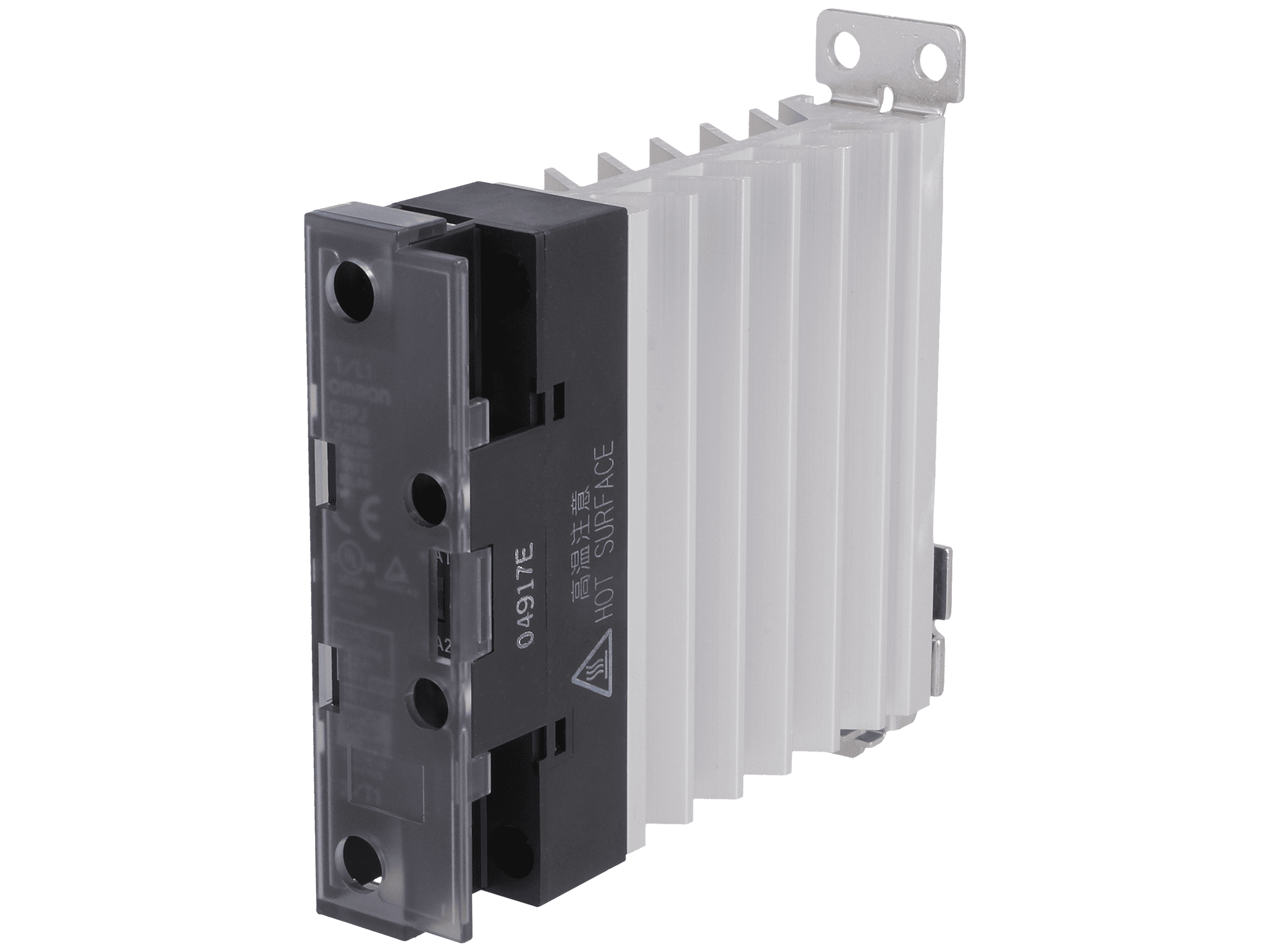
SSR relays, i.e., based on semiconductors, are increasingly chosen for automation applications, mainly because of their lifespan and fast actuation. The G3PJ series solutions are single-phase relays supporting currents of 15A or 25A (24…480V AC). They feature a zero-crossing trigger controller that reduces disturbances in power supply circuits. The integrated heatsink in the body improves heat dissipation generated at semiconductor terminals, allowing use in varied thermal conditions (from -30°C to 80°C).
Contactors Series J7KC/J7KCA
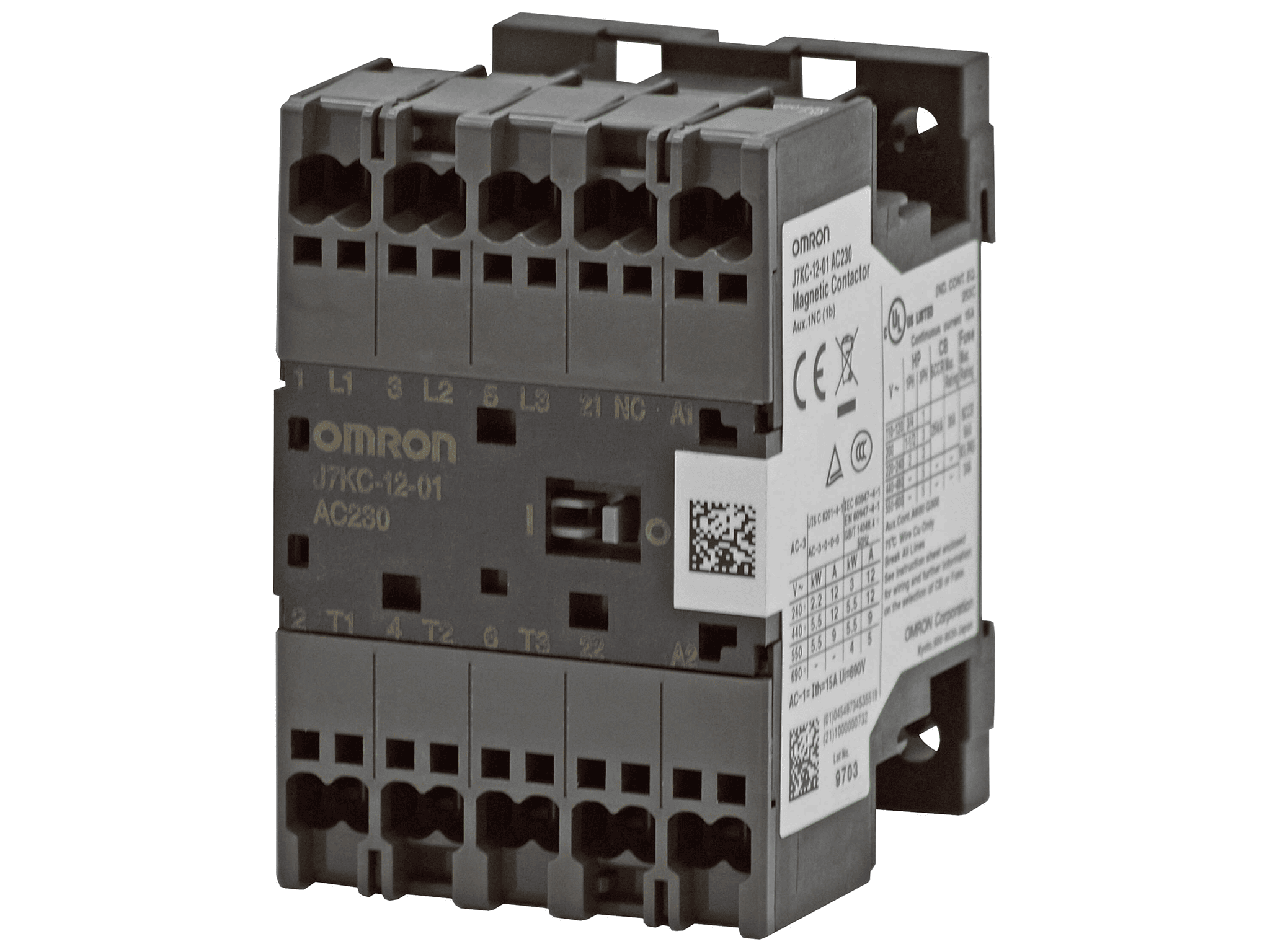
Contactors are typically used where frequent switching of high load circuits is required. Omron offers J7KC and J7KCA series solutions able to handle currents up to 12A, which translates to controlling loads with a maximum power of 2.2 kW or 5.5 kW. They are still compact components (45 mm or 90.5 mm wide), 3- and 4-pole (including latching) in configurations NC + NOx3, NCx2 + NOx2, or NOx4. Selected versions feature an impulse current suppression circuit excited by the coil.
Time Relays
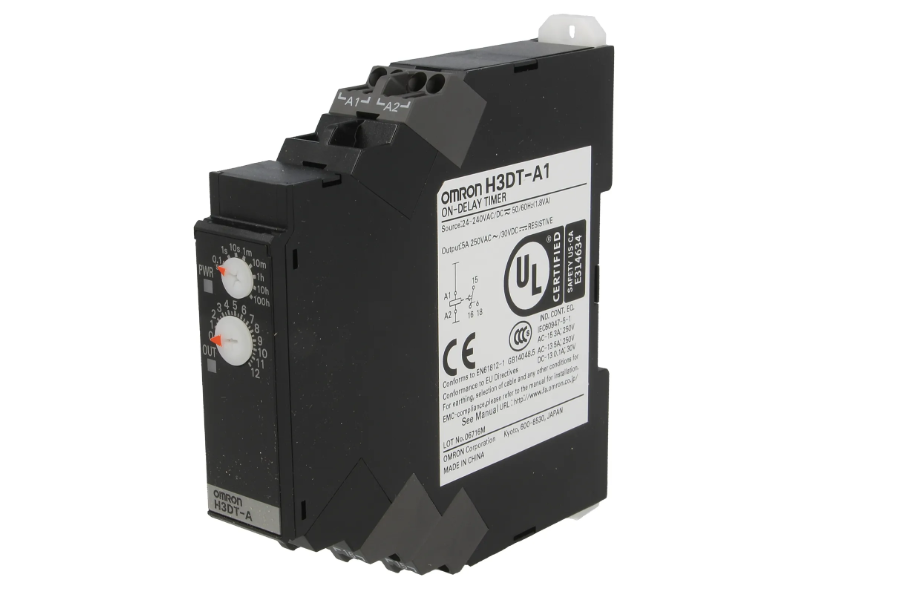
Time relays are used in various automation systems, controlling entire process stages or individual machines. Omron offers diverse models of such modules, including complex, digital timers capable of reproducing complex signal sequences at precise intervals. The H3DT series models have more basic functionality. They count in the range of 0.1s to 1200h and can control circuits under voltages up to 250V AC and currents up to 5A. Their outputs use relays configured as SPDT or DPDT. Depending on the model, power supply voltages can be 24…240V AC/DC. The relays have various operating modes: cumulative, delayed on/off (also relative to external signals), cyclic operation with adjustable intervals.
SUPERVISORY RELAYS
Another important segment of relays includes supervisory elements that form the foundation of machine and entire installation protection against factors beyond the scope of typical overcurrent and residual current protections.
K8DT-VS Voltage Supervisory Relays
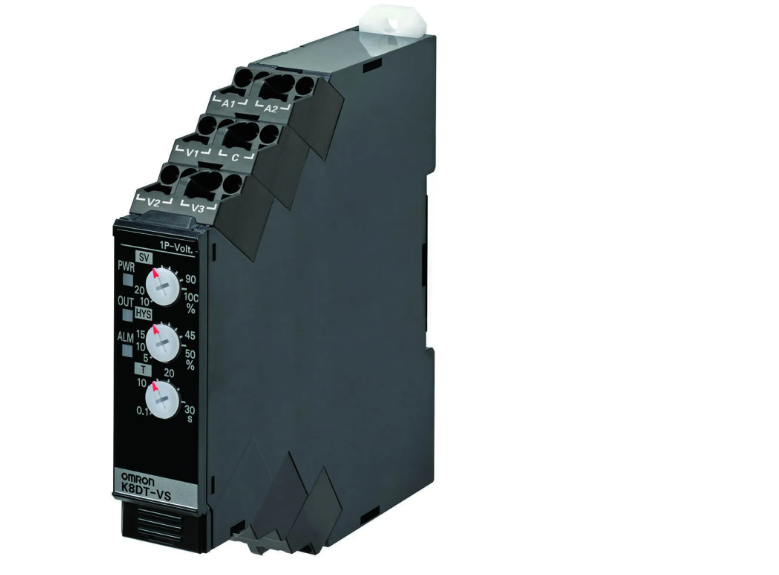
Voltage supervisory relays detect improper power supply parameters that could cause equipment failure. Monitoring covers both voltage drops and rises in AC or DC circuits. The installer sets hysteresis and actuation time (maximum delay 30s) via potentiometers. Controlled parameters range from 1V to 600V (depending on the model). A single module measures 90x90mm with a width of 17.5mm. It is worth
K8DT-TH Temperature Supervisory Relays
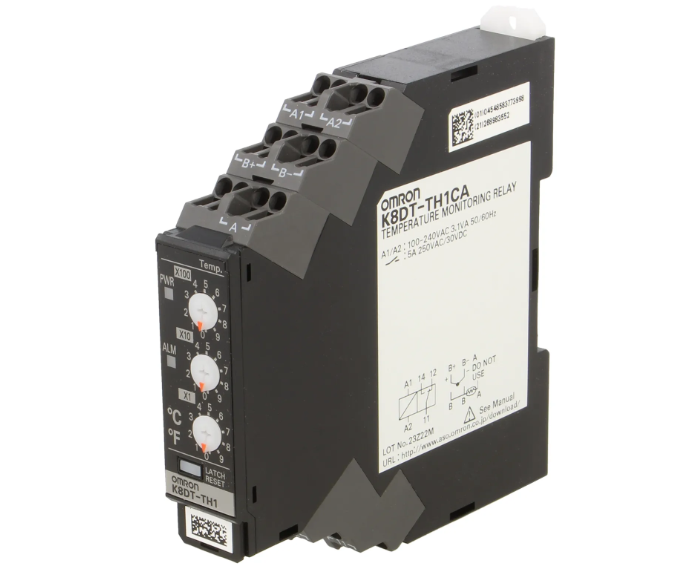
Temperature supervisory relays are designed primarily for use in systems using heaters, i.e., in many types of industrial processes. The setting is intuitive, and available ranges for installers are 0…999°C or 0…1800°C. Modules are compatible with sensors type Pt100, Pt1000, and thermocouples B/E/J/K/PLII/R/S/T. Versions with transistor or relay (SPDT) outputs are available.
Liquid Leakage Supervisory Relays
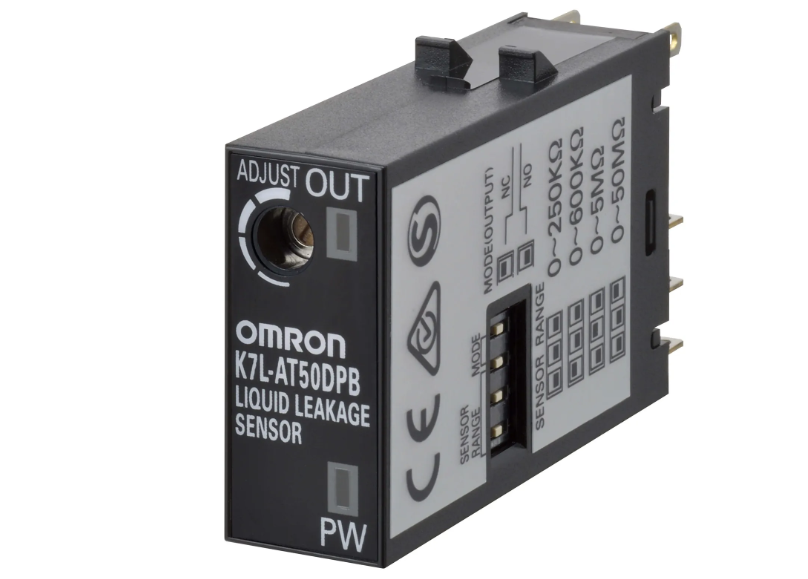
In places where water or chemical leaks may occur, critical roles are played by supervisory relays capable of detecting leaks and liquid presence, even if they have low conductivity. K7L series models can work with sensors up to 400m away. The elements require power supply in the range of 10…30V DC. The transistor output may have NPN, PNP, or dual PNP/NPN configuration. An additional feature is sensor disconnection detection. Modules have only one adjustment knob related to threshold resistance value.
MOTOR CIRCUIT BREAKERS J7MC
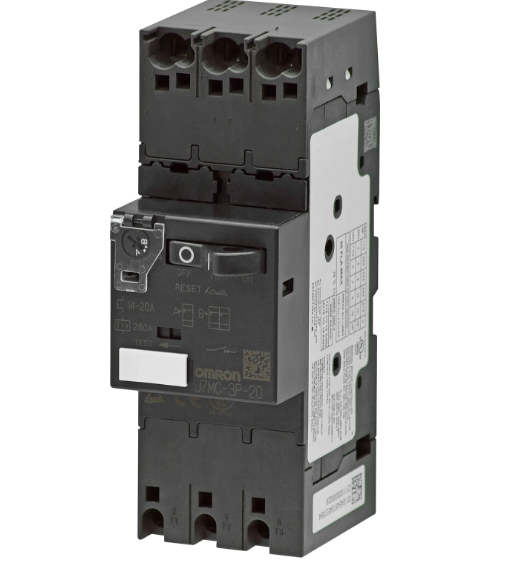
Motor circuit breakers in the J7MC series provide protection for drive power circuits up to 11 kW (depending on the version), for both single- and three-phase systems. Overcurrent trigger adjustment ranges from 0.1…0.16A to 14…20A, covering virtually all typical needs encountered in industrial automation installations. The adjustment knobs are protected by covers to prevent accidental setting changes. The modules can also be used as simple motor on/off switches, e.g., for immobilizing machines during maintenance.
CONTROLLERS AND COUNTERS
Omron’s offering also includes more complex control components, such as controllers and counters. These basic control elements have also been miniaturized in accordance with the Value Design philosophy.
E5CC Temperature Controllers
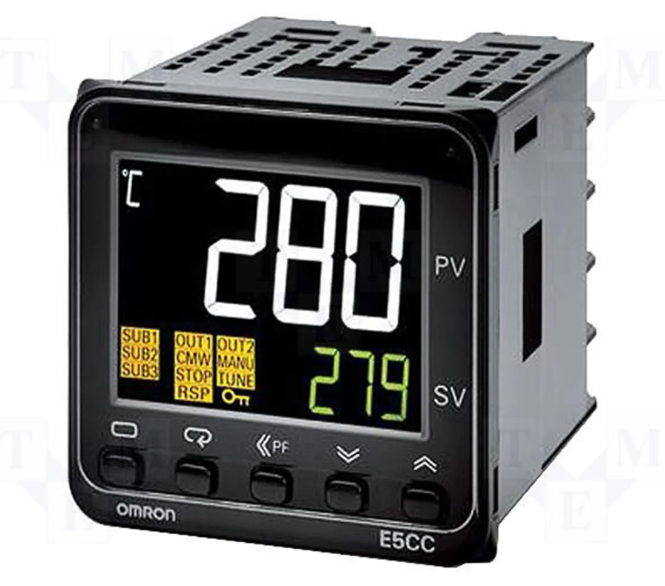
Unlike supervisory relays, temperature controllers have complex functionality. The most noticeable advantage is the large, clear LCD displays showing the setpoint and currently measured temperature. They also allow quick inspection of selected options: sensor type, sensitivity, output configuration. Module adjustment is performed using an integrated keypad or by connecting to a computer with CX-Termo software (via USB cable). E5CC series models operate on power supply voltages 24V AC/DC or 100…240V AC, feature relay and analog (current) outputs for remote monitoring of thermal conditions. Controllers have a high IP protection level of IP66 (front side). The products can control both heating and cooling installations.
H7CC Counters
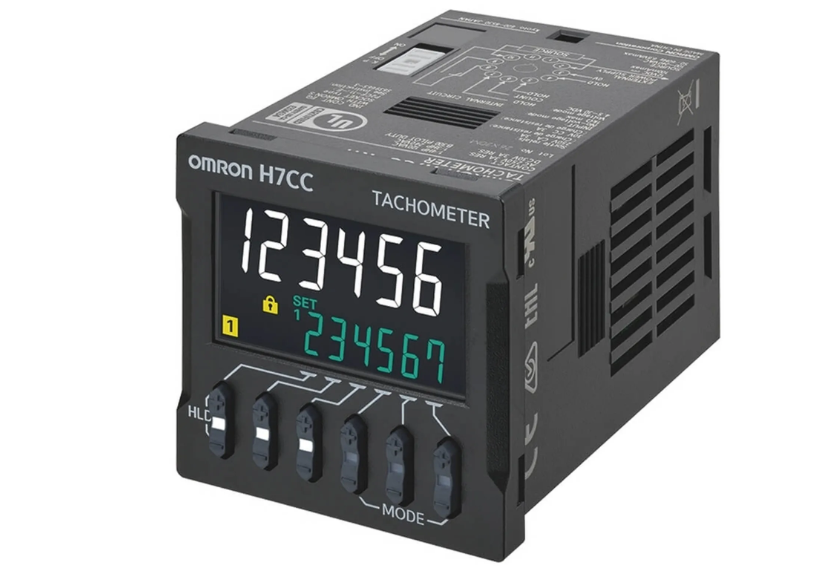
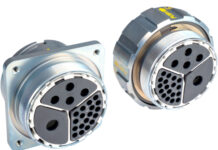
The new generation of Omron counters simplifies programming, maintenance, and makes work easier both for users and installers. The intuitive interface is based on a keyboard and a large, backlit LCD display. Modules can operate incrementally/decrementally, with a setpoint, and also in tachometer mode. Connections are made using screw terminals or industrial circular connectors. All models have contact, NPN, and PNP inputs, making these products versatile solutions. The counting range is one million pulses (-999999…999999). Power supply parameters are broad (12…48V DC, 100…240V AC). H7CC series counters are adapted for DIN rail (TH35) or base mounting, with an option for panel mounting in all cases.
DIN RAIL POWER SUPPLIES
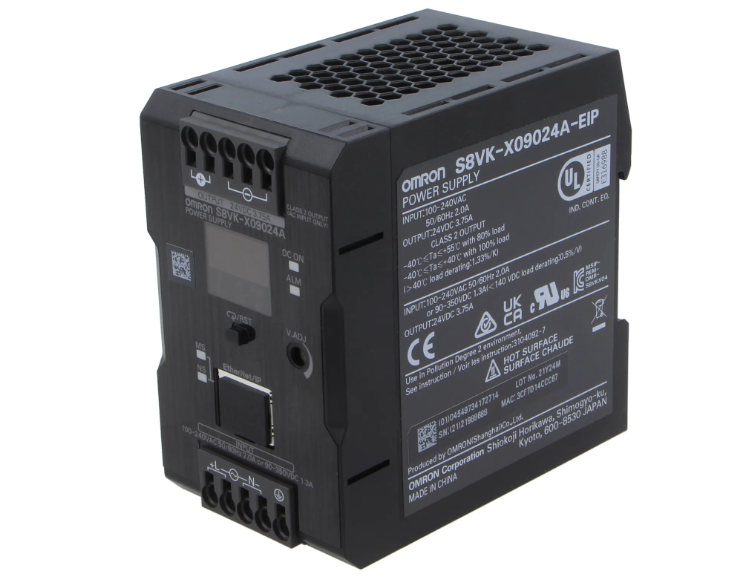
S8VK series power supplies come in several subcategories. Generally, these components are designed to power the latest control systems in industrial automation, mainly those based on IoT and technologies such as Ethernet, Modbus, TCP protocol. The units themselves can also be remotely managed, i.e., via networks, although operational status can be checked locally – the panel features LED indicators and, in S8VK-X… models, a display. Devices deliver voltages of 5V/12V/24V/48V DC and have power ratings up to 480W (boost function enables momentary output of 150% power to cover inrush currents). Products use switching technology, achieving efficiency up to 93%.
A22N SERIES PANEL SWITCHES
Finally, let us also highlight the wide range of panel switches from the A22N family. This offer comprises several thousand panel-mount elements with varied designs, colors, and purposes. These are panel mounting components with a 22.3 mm hole. Available versions include mono-, bistable, and 3-position switches with various contact configurations. The portfolio includes models with LED illumination and keys in different shapes. Most of them boast an IP66 protection rating, meaning complete dust resistance and high water resistance.
It is worth noting that A22N series switches are modular, with interchangeable contacts, allowing the customization of elements to the application’s requirements. Contact inserts are also available from TME.
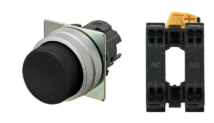
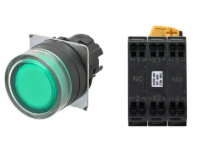
Omron has also anticipated not only a wide color selection (white, black, red, blue, orange, yellow) but also various types. Besides classic push switches, the portfolio includes rotary versions, including key-lockable types, allowing controlled machine and circuit shutdowns, e.g., preventing power supply during servicing.


It is worth noting that a significant subgroup of Omron switches consists of safety elements. They are used for immediate, manual circuit opening/closing in emergency or alarm situations. Often, they not only serve as the main power line but also simultaneously trigger alarms or light signals. To improve protection, many of these switches require an additional action to reset (e.g., turning a knob).
For more information visit: https://www.tme.com/.