

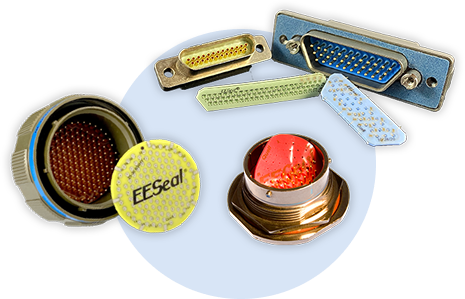
Quell EESeal EMI Filtering – Quell, for which Astute Group is an authorised distribution partner, develops connector-level EMI/RFI solutions for applications where signal, voltage, frequency, environmental and physical constraints all influence the required filtering approach. The company’s EESeal technology is designed to fit over connector pins, with individual pins configurable using capacitors, resistors, MOVs, diodes and other components.
Choosing an EMI filtering approach starts with the connector, its pin configuration and the interference path through the cable or interface. Quell’s EESeal® range gives Astute Group customers a way to apply targeted filtering, transient protection and grounding at connector level without replacing the existing connector or redesigning the PCB.
Start with the connector and EMI path
The connector type, pinout and available space establish the starting point for a filter design. The electrical requirements then determine how individual pins need to be treated.
Quell’s EESeal design process considers the connector part number, problem frequencies, voltage on each pin and maximum data rate. Its military vehicle case study also identifies additional requirements such as lightning pulse specifications where applicable.
This pin-level approach matters where different signals require different treatment. Quell states that EESeal inserts can provide individual pin configurations, including capacitors, resistors, MOVs and diodes, while selected pins can remain open or be shorted.
The result is a filtering arrangement matched to the electrical requirements of the connector rather than applying the same filter configuration across every circuit.
EESeal provides a retrofit route for existing connectors
Where EMI problems are identified after a connector or PCB design has been established, replacing the connector or returning to the board layout can introduce additional engineering work.
Quell describes EESeal as a way to “Turn Your Connector into a Filtered Connector”, with the insert fitting directly over the connector pins. The silicone construction allows the insert to be installed without specialist tooling, while maintaining the environmental seal of the host connector.
Astute’s Quell product information states that EESeal inserts can be used with circular, D-Sub, Micro-D, ARINC, LEMO and custom connector formats. Quell also lists MIL-C-38999, MIL-C-26482, MIL-C-5015 and other connector families among supported types.
This makes connector-level filtering relevant both at initial design and where EMC problems emerge during testing or after equipment has been deployed.
Match the filter technology to the frequency requirement
Quell offers several approaches within the EESeal family.
The standard EESeal® provides custom pin-level filtering using discrete components, with Quell specifying attenuation from 10 kHz to 40 GHz and peak attenuation of up to 40–45 dB. The company also offers EESeal+®, which uses a high-dielectric-constant silicone construction for high-frequency applications, with filtering up to 100 GHz and peak attenuation of up to 50 dB.
Quell states that EESeal+ uses integral capacitors in the 2–6 pF range with virtually no inductance. Its published comparison shows that the same discrete capacitor value can produce different attenuation characteristics between EESeal and EESeal+, making the connector construction and frequency range part of the filter selection process.
For applications requiring transient or ESD protection as well as EMI filtering, Quell’s connector solutions can incorporate MOVs and diodes. Its wider product range also includes ESDSeal™ TVS diode arrays, gaskets and filtered connector solutions.
Stay ahead on electronics news
Join the electronics industry Astute Engineer newsletter
Consider environmental and mechanical constraints
Filtering cannot be separated from the physical environment in which the connector operates. Quell states that EESeal products use resilient silicone construction and have been tested against requirements including MIL-STD-1344 shock, vibration, salt spray, durability, fluid immersion and porosity, as well as RTCA/DO-160 thermal cycling and humidity, MIL-STD-5400 temperature and altitude requirements, and NASA outgassing.
The insert also adds little physical mass. Quell states that EESeal adds less than one gram to connector weight, while its construction is designed to fit within the existing connector interface.
For equipment subject to space, weight or enclosure constraints, these characteristics can affect whether connector-level filtering is practical compared with a larger filtered connector assembly.
Astute Group provides access to the Quell EESeal portfolio as an authorised distribution partner, supporting connector-level EMI filtering, transient protection and related solutions for aerospace, defence, industrial, medical, automotive, space and transportation applications.
Selecting the appropriate filtering approach therefore starts with the connector interface and the problem being addressed. Pin configuration, frequency, voltage, signal type, grounding, transient requirements and environmental conditions can all determine whether an EESeal, EESeal+, transient protection, gasket or filtered connector solution is appropriate.
Damian Semple, Franchise Marketing Manager, comments: “Connector filtering is often considered after an EMI problem has appeared, but the connector interface can be specified for filtering from the outset. Having configurable options at pin level also gives projects a practical route to address a defined interference problem without automatically changing the wider hardware design.”
Next steps
Request an EESeal sample or a short demo via Astute to evaluate fit against your current enclosure design.