

OECD Broadband Statistics 2025 – The rapid growth of artificial intelligence (AI), cloud computing and connected devices is increasing demand for faster, more reliable connectivity across the OECD, according to the latest OECD broadband statistics. To meet these needs, OECD Member countries are upgrading digital infrastructure and shifting from expanding access to improving network performance.
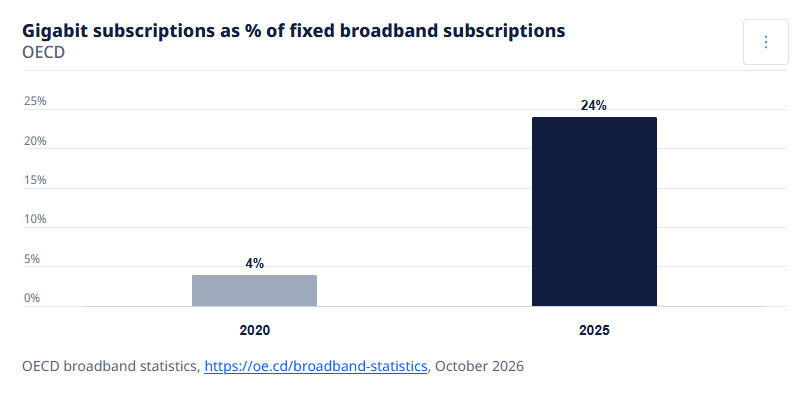
Demand for high-capacity networks is reflected in the rapid expansion of high-performance broadband offers across the OECD. Gigabit-capable subscriptions increased from 4% of fixed broadband subscriptions in 2020 to 24% in 2025, a six-fold increase in just five years.
Growing demand for mobile data
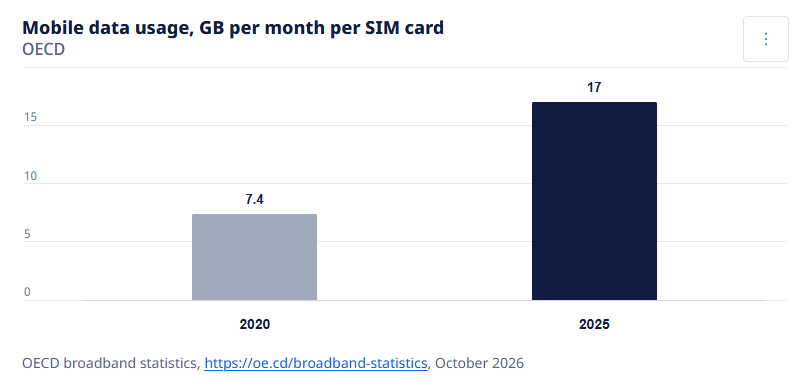
By 2025, mobile data use across the OECD reached 17 GB per SIM per month, up by 130% from 7.4 GB in 2020, as users increasingly rely on mobile networks for data-intensive activities. The Slovak Republic saw the most significant growth at an annual rate of 42% during 2024-25, from 1.4 GB to 8.2 GB. Bulgaria, Czechia and Greece also experienced rapid annual growth (38%, 37% and 36% respectively). Meanwhile, Latvia (66 GB), Lithuania (54 GB) and Finland (49 GB) had the highest mobile data usage per subscription. This trend reflects growing demand for mobile data, supported by the expansion of 5G, more affordable plans and connected devices.
Fast, reliable fibre and 5G networks are powering today’s use of transformative digital technologies
As demand for reliable, high-speed connectivity grows, fibre continues to expand across the OECD. Fibre now accounts for more than half (51%) of all fixed broadband subscriptions across the OECD, up from 31% in 2020. This shift is taking place in largely mature fixed broadband markets: OECD average fixed broadband penetration grew by only 2.2% per year in the last five years between 2020 and 2025, from 33 to 37 subscriptions per 100 inhabitants.
Fibre growth mainly reflects the migration of existing subscribers from legacy technologies such as DSL and cable. Greece recorded the highest annual growth in fibre subscriptions between 2020 and 2025 (162%), followed by Peru (63%), Belgium (57%), Israel (55%) and the United Kingdom (55%), as operators expanded fibre networks to meet growing demand for high-speed connectivity.
Fibre adoption increased across all regions where OECD countries are present between 2020 and 2025, with particularly strong growth in Latin America, reflecting continued investment in high-capacity networks. For example, fibre share of total fixed broadband in OECD LATAM countries has almost tripled from 24% to 68% between 2020 and 2025.
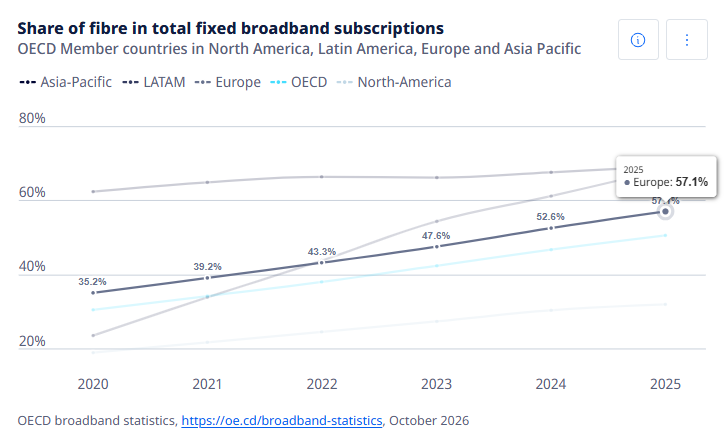
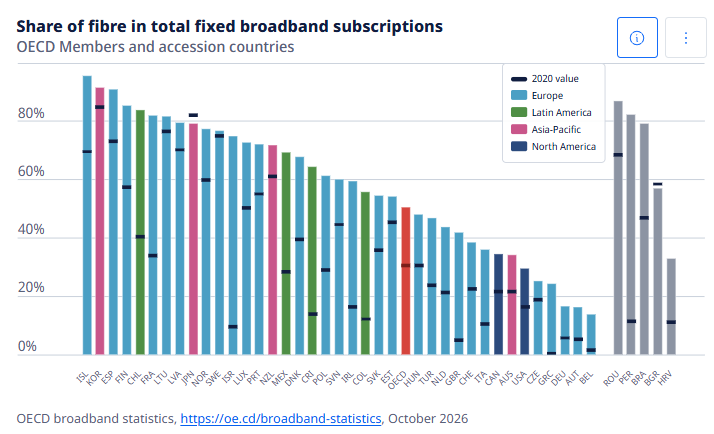
At a cross-country level, eight OECD countries had fibre shares (in total fixed broadband) above 80% in 2025: Iceland (96%), Korea (92%), Spain (91%), Finland (85%), Chile (84%), France (82%), Lithuania (82%) and Latvia (80%). Six of these leaders are European, although Europe also shows substantial heterogeneity, with Germany, Austria and Belgium recording the lowest fibre shares, all below 20%. Among OECD accession countries, fibre accounts for a large share of fixed broadband connections in most cases exceeding the OECD average of 51% in Romania (87%), Peru (83%), Brazil (79%) and Bulgaria (57%), while Croatia remains below the OECD average at 33%. Several OECD countries also made significant progress between 2020 and 2025, with fibre shares increasing by more than 40 percentage points in Israel, Costa Rica, France, Colombia and Chile.
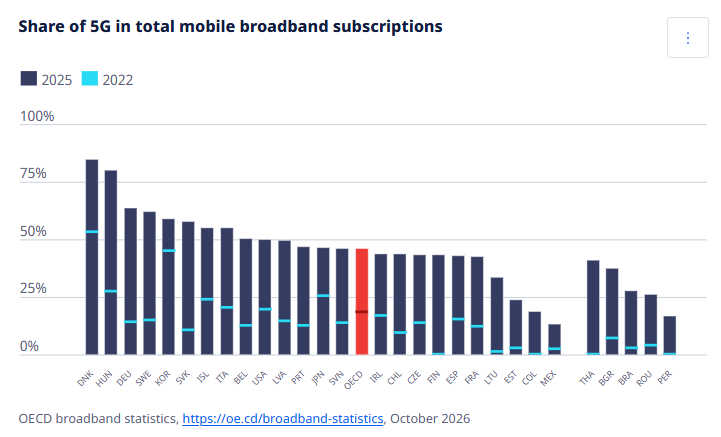
5G is now deployed in all OECD countries and is becoming the dominant mobile technology across the OECD, accounting for 46% of mobile broadband subscriptions in 2025, up from 19% in 2022. Its high capacity and low latency support data-intensive applications, including AI services, cloud computing and connected devices.
Adoption varies widely across countries: in 2025, 5G accounted for more than 60% of mobile broadband subscriptions in Denmark (85%), Hungary (80%), Germany (64%) and Sweden (62%), while it remained below 25% in Estonia, Colombia and Mexico, likely due to the timing of spectrum auctions. Hungary, Germany and the Slovak Republic recorded the strongest growth since 2022, each gaining around 50 percentage points in the last three years (2022-2025 period). Among accession countries, Thailand (41%) and Bulgaria (37%) are approaching the OECD average, while Brazil (28%), Romania (26%) and Peru (17%) are still at an earlier stage of 5G uptake.
Fixed and mobile broadband networks are getting faster and higher quality in mature markets
Total fixed broadband across the OECD grew at an annual rate of 2.2% from 2020 to 2025, reflecting a maturing fixed broadband market as subscriptions per 100 inhabitants increased from 33 to 37 during that period. Total mobile broadband subscriptions across the OECD grew at an annual rate of 4.6% from 2020 to 2025, reaching 2.03 billion in 2025. Over the same period, subscriptions per 100 inhabitants increased from 118 to 144, indicating that markets are approaching maturity. Despite this, subscriptions continue to grow steadily, driven by rising demand for mobile data, the expansion of 5G networks and the proliferation of connected devices. This sustained growth underlines the central role of mobile broadband in both consumer and business connectivity.
While the shift towards fibre continues to reshape fixed broadband markets across the OECD, fixed wireless access and satellite broadband are gaining ground extending coverage in underserved areas.
Fixed wireless access and satellite broadband are growing and can help close connectivity gaps
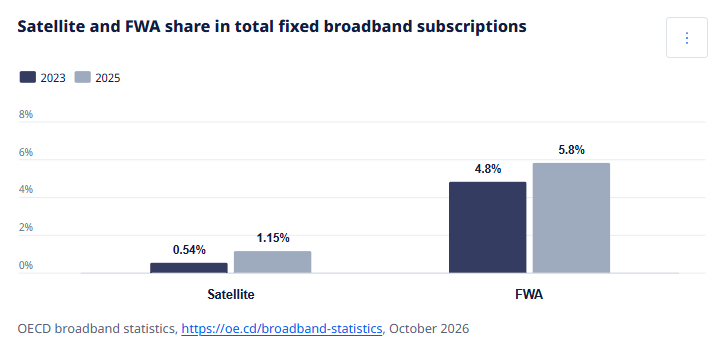
Fixed wireless access (FWA) is playing an increasingly important role in expanding broadband connectivity where deploying fibre is difficult or costly. Across the OECD, FWA accounted for 5.8% of fixed broadband subscriptions in 2025, up from 4.8% in 2023. Reliance on FWA is much higher in some countries. Czechia leads the OECD with 38% of fixed broadband subscriptions delivered through FWA, followed by Bulgaria (23%), the Slovak Republic (22%), Croatia (21%) and New Zealand (20%). These figures highlight the role of FWA as a complementary technology that can help expand high-speed connectivity in rural, remote and underserved areas.
Developments in satellite connectivity in the past two years are reshaping communication markets with the rise of direct-to-device communications and the growth of fixed satellite broadband connections. While satellite fixed broadband remains a small share of total fixed broadband connections, it is one of the fastest growing components of the OECD connectivity landscape: its share more than doubled in two years, from 0.5% in 2023 to 1.15% in 2025, and total satellite subscriptions grew 122% over the same period. The United States recorded the highest number of satellite subscriptions in 2025 (4 million), followed by Australia and Mexico. While adoption remains concentrated in countries with large remote or sparsely populated areas, satellite broadband continues to play an important role in extending connectivity where terrestrial networks are difficult or costly to deploy.
Legacy broadband access technologies continue to decline
DSL subscriptions declined by 47% across the OECD between 2020 and 2025, as users increasingly migrated to higher-capacity fibre networks. The decline was particularly pronounced in countries that have expanded fibre infrastructure rapidly, including Greece, Belgium and Israel. The decline of DSL marks a structural shift in fixed broadband, as operators phase out legacy technologies in favour of a future-proof digital infrastructure.
Cable subscriptions declined by 16% across the OECD between 2020 and 2025, reflecting growing competition from both fibre and 5G networks. Despite this decline, cable remains an important part of the broadband landscape in some countries, accounting for more than half of fixed broadband subscriptions in the United States (54%) and Belgium (51%) and maintaining a significant role in Canada (47%), the Netherlands (39%) and Hungary (39%). However, as fibre deployment expands and wireless technologies continue to improve, cable’s share of the market is gradually declining.
Machine-to-Machine (M2M) subscriptions grew by 98% from 2020 to 2025 across the OECD, driven by the expansion of the Internet of Things (IoT) and industrial automation. Lithuania recorded the highest annual growth rate (42%), followed by Spain (40%) and Portugal (36%). In absolute terms, the United States had the largest number of M2M subscriptions in 2025 (282 million), followed by Germany (86 million). This continued expansion of M2M connectivity reflects its growing role in applications ranging from industrial automation and logistics to smart cities and connected digital infrastructure, as well as the increasing number of connected devices owned by individuals, such as smartwatches, connected cars and smart home appliances.
Connectivity shifts towards quality and performance
Across the OECD, connectivity is increasingly defined by quality as well as access. The expansion of fibre and 5G networks, alongside the growth of fixed wireless access and satellites service, is improving the speed, capacity and reliability of digital connectivity.
At the same time, declining prices and growing availability of gigabit-capable services are making high-performance connectivity more accessible to households and businesses. As demand for data-intensive applications continues to grow, OECD countries are continuing to invest in the networks needed to support the next generation of digital services.
Broadband data, charts and maps by country are available for download and can also be visualised in the OECD Data Kitchen.