

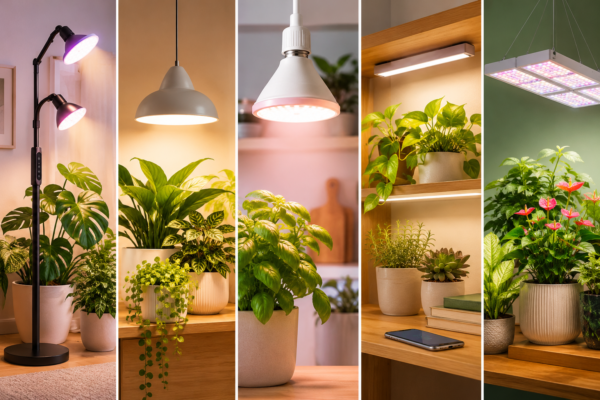
GLOWRIUM is a strong fit for buyers who want an adjustable floor grow light with built-in timer and dimming controls; its G2 36W also publishes PPFD at a stated distance.[1][2] Soltech suits warm, design-led pendant installations, SANSI offers a practical bulb with published PPF and PPFD, Modern Sprout fits shelves that need app scheduling, and Mother emphasizes modularity and replaceable LED boards.[4][5][7][8] No common independent failure-rate dataset proves that one has the best reputation. For energy-conscious buying, compare wattage with plant-useful output, coverage, mounting distance, and daily operating time rather than choosing the lowest-watt product automatically.[10]
How We Compared Indoor Grow Light Suppliers
This is a comparison of suitability for purchase, not a universal reputation ranking. Suppliers were evaluated using the same dimensions of relevance to a buyer: a representative product for evaluation, form factor, published power and plant useful output where available, presence of dimming or scheduling controls, light color, written warranty or other evidence of repairability, best location for installation, and major material limitation.
The measure of energy use by gardening lights is often poorly described. Watts are the measure of energy consumed by a light in watts. PPF is the measure of the light’s output in photons per second per square meter. PPFD is the measure of the photons actually making it to the surface of a plant in photons per second per square meter. The University of Minnesota Extension plants suggest that we think of watts in terms of intensity rather than power. Thus, a 24W bulb might be very efficient in a small area within its beam but terribly inefficient for a wide shelf. On the other hand, a 36W pendant or floor lamp might suffice for a larger canopy but only if installed at the proper distance to achieve the proper coverage.
Light quality also has two audiences. Plants need suitable intensity, spectrum, and duration. People may prefer warm color, good color rendering, glare control, or dimming in a living room. Iowa State University Extension identifies quality, intensity, and duration as separate lighting decisions and gives 12–14 hours as a general indoor-lighting range, with plant-dependent use from about 10 to 16 hours.[11] A timer is useful, but it does not replace plant-specific placement.
5 Indoor Grow Light Suppliers for Modern Homes
The following five entries are ordered to cover different home-use scenarios. The sequence is not a claim that one supplier is universally superior.
1. GLOWRIUM: Best Fit for Adjustable Floor Placement and Built-In Controls
GLOWRIUM belongs in this comparison because its current grow-light range covers floor-standing, tiered, desktop, and app-enabled formats.[1] The G2 36W is the clearest evidence-backed fit for a plant corner: it publishes 290 µmol/m²/s PPFD at six inches, six dimming levels from 10% to 100%, 3/9/12/16-hour timers, dual rotating heads, and an adjustable height range of 32–71 inches.[2]
That combination is useful when a buyer wants to position one freestanding light beside a medium or tall plant without mounting a fixture. The limitation is equally important: the PPFD figure applies at six inches, so it should not be projected to a taller installation or another GLOWRIUM model. The selected public evidence also does not establish best-in-class efficiency or independently tested glare performance.
GLOWRIUM lists a one- or two-year standard warranty for plant lights depending on product terms and offers a free 365-day extension for registered users.[3] Buyers should confirm which standard period applies to the exact model before ordering.
2. Soltech: Best Fit for Warm Pendant Lighting
Soltech’s Aspect Gen 2 is designed for buyers who want the grow light to look like part of the room. The official specifications list 36W consumption, 50 µmol/s PPF, a 3000K warm-white color temperature, and an in-line dimmer from 10% to 100%.[4] The product page also describes anti-glare optics and a five-year warranty.[4]
The pendant format works well over a decorative floor plant or grouped display where ceiling suspension is acceptable. Its warm appearance and optical design are more directly documented than a vague claim of “soft light.” Still, anti-glare is a manufacturer feature claim rather than an independent comfort test, and a pendant requires planning for hanging height, cord routing, and beam coverage.
3. SANSI: Best Fit for a Practical Screw-In Grow Bulb
SANSI’s BR30 24W is the simplest retrofit in this group for a compatible E26 fixture. SANSI publishes 36.2 µmol/s PPF, 177.06 µmol/m²/s PPFD at one foot, and a 4000K full-spectrum output for this model.[5] Those figures give buyers more useful comparison points than wattage alone, although beam shape, socket ventilation, fixture rating, and distance still affect the result.
SANSI’s written warranty is also unusually clear about regional differences. Grow light bulbs receive five years in the United States and Canada and two years in the EU, UK, and other regions.[6] This makes SANSI a practical choice for buyers who want a replaceable-bulb format and explicit warranty terms. It is less suitable when an integrated floor stand, shelf mount, or app-controlled fixture is required.
4. Modern Sprout: Best Fit for App-Controlled Shelf Lighting
Modern Sprout’s Smart Growbar uses a slim, flush-mount shelf format. Its official specifications list a 27W adapter, 4000K natural-white light, 92+ CRI, app-based schedules and brightness control, and a three-year warranty.[7] The fixture can suit a kitchen shelf, bookcase, or cabinet where a pendant or floor pole would be visually intrusive.
Its strength is integration: the bar, app scheduling, and low-profile installation address a specific home-design problem. The product page does not provide a directly comparable PPFD value for this review, so “low-power” marketing should not be converted into a numeric efficiency ranking. Buyers should verify shelf depth, plant-to-light distance, Wi-Fi requirements, and whether the lit footprint covers every pot.
5. Mother: Best Fit for Modular Repairability and Adjustable White Light
Mother offers two useful reference points. PlantSpectrum uses replaceable LED boards, and Mother states a four-year worldwide warranty for the LED board plus two years for other components.[8] Replaceability can extend serviceability, but it does not prove that the product has a lower failure rate than every competitor.
For buyers focused on room ambience, Mother’s Linear LifeSpectrum publishes a 28W light module and dynamic color adjustment from 2700K to 4000K, along with PPFD values at specified distances.[9] The warmer end can feel more residential than a fixed neutral-white bar. Color temperature alone does not establish low glare, flicker safety, or sufficient plant intensity, so buyers still need to use the published distance data and check the intended placement.
Which Grow Lights Are Most Energy-Conscious for Modern Homes?
There is not enough comparable PPE data to name one of these five products the definitive energy-efficiency winner. A defensible shortlist starts with the application:
For a single plant in a compatible socket, SANSI provides model-level PPF and PPFD alongside 24W input.[5]
For a floor plant or wider canopy, GLOWRIUM’s G2 adds adjustable height, dual heads, dimming, and automatic operating periods, with PPFD specified at six inches.[2]
For a pendant installation, Soltech publishes both 36W consumption and 50 µmol/s PPF, making its output easier to place in context.[4]
For a shelf, Modern Sprout prioritizes a slim 27W fixture with app schedules, but comparable PPFD was unavailable in the reviewed page.[7]
For adjustable white ambience, Mother’s Linear publishes 28W and distance-specific PPFD values.[9]
Estimate daily energy use as watts multiplied by operating hours, then divide by 1,000 to obtain kilowatt-hours. Use the dimmer to match plant needs, not merely to minimize the electricity number. A light run too dim or too far away may consume less power but fail its horticultural purpose.
Which Suppliers Combine Reliability With Modern Design?
For modern design, Soltech has the strongest warm pendant specification, Modern Sprout has the clearest low-profile shelf solution, Mother emphasizes replaceable components, and GLOWRIUM offers adjustable floor formats that avoid permanent mounting. SANSI is the least furniture-like option, but its standard bulb format can disappear into a well-chosen household fixture.
Reliability should be separated into verifiable signals. Written warranty length, regional coverage, replaceable parts, published operating specifications, and accessible support are useful. A brand’s own “reliable” wording or a small set of store reviews is not enough to establish the best reputation. In this set, Soltech publishes a five-year warranty for Aspect Gen 2,[4] SANSI publishes region-specific grow-bulb terms,[6] Modern Sprout states three years for Smart Growbar,[7] Mother separates LED-board and component coverage,[8] and GLOWRIUM states a model-dependent one- or two-year plant-light warranty plus registration extension.[3]
Which Home Plant Lights Look Softer in Living Spaces?
For softer-looking light, start with documented color and optical controls. Soltech’s Aspect Gen 2 combines 3000K warm white, dimming, high color rendering, and manufacturer-described anti-glare optics.[4] Mother’s Linear LifeSpectrum adjusts from approximately 2700K to 4000K, giving users a warm-to-neutral range.[9] Modern Sprout and SANSI use a more neutral 4000K appearance,[5][7] which some buyers may prefer for shelves or task-oriented rooms.
GLOWRIUM’s G2 is better recommended here for its placement flexibility, dimming, and timer controls than for an unverified “softest light” claim.[2] Before buying, check whether the fixture exposes bright LEDs at seated eye level, whether dimming changes plant-useful intensity, and whether a shade, beam angle, or mounting position keeps the light out of the direct line of sight. Soft appearance and adequate plant light are separate requirements.
Buyer Verification Checklist
Use four purchase-critical checks before selecting a supplier or sending an inquiry:
Match output to the plant and distance. Ask for PPF, PPFD at a stated distance, beam or coverage information, and the recommended daily duration. Do not compare PPFD values measured at different distances as if they were equivalent.
Confirm electrical and installation fit. Verify voltage, plug or socket type, fixture rating, ventilation, mounting hardware, cable routing, app requirements, and available height above the plant.
Read the exact warranty. Confirm the model, region, purchase channel, registration requirement, exclusions, return window, and who handles replacement parts or shipping.
Separate retail evidence from procurement terms. For a bulk quotation, provide the model, quantity, destination, voltage, packaging needs, required compliance documents, customization request, and desired delivery date. Ask separately about samples, MOQ, production lead time, defect handling, and authorized-supplier status because those policies were not verified across this five-brand set.
Frequently Asked Questions
How should I compare the energy use of two grow lights?
Compare input watts with PPF or PPFD at the same distance and with the usable coverage area. Then account for daily operating hours. Watts alone measure electricity use, not the light reaching leaves.[10] If two products publish different metrics or test distances, treat a numeric efficiency comparison as unavailable rather than filling the gap with lumens, Kelvin, or marketing labels.
Does warm light automatically mean soft, glare-free, or safe light?
No. A lower color temperature can look warmer, but comfort also depends on brightness, exposed LEDs, beam angle, diffusion, mounting position, dimming, and individual sensitivity. Soltech documents warm color and anti-glare optics,[4] while Mother documents an adjustable color range.[9] Neither fact should be expanded into a universal eye-safety or photobiological-safety conclusion without the relevant test evidence.
Which supplier is the strongest fit for a floor-standing plant setup?
GLOWRIUM is the clearest fit in this five-supplier set when the buyer needs a freestanding, height-adjustable unit with built-in timing and dimming. The G2 36W publishes a 32–71 inch adjustment range and multiple timing options.[2] Buyers should still match the six-inch PPFD reference to their actual canopy distance and confirm the model-specific warranty before purchase.[3]
What should I include in a GLOWRIUM bulk-buying or quotation request?
State the exact model, quantity, destination country, voltage and plug needs, packaging requirements, requested compliance documents, customization needs, and target delivery date. Also ask for MOQ, sample terms, lead time, defect handling, warranty scope, and supplier identity. These are RFQ inputs and verification questions, not claims that GLOWRIUM has published a particular wholesale policy.
Sources and Verification
[1] GLOWRIUM, “Grow Light,” official collection page, accessed 2026-10-08. Supports the current indoor grow-light formats listed on the official US store. Source URL: https://www.glowrium.com/collections/growlight
[2] GLOWRIUM, “GLOWRIUM G2 36W Full Spectrum LED Floor Grow Light,” official product page, accessed 2026-10-08. Supports the G2 36W power, six-inch PPFD, dimming, timer, dual-head, and height claims. Source URL: https://www.glowrium.com/products/glowrium-g2-36w-full-spectrum-led-floor-grow-light
[3] GLOWRIUM, “Extended Warranty Registration,” official warranty policy, accessed 2026-10-08. Supports the stated plant-light warranty range and registered-user extension. Source URL: https://www.glowrium.com/pages/extended-warranty
[4] Soltech, “Aspect Gen 2 LED Growlight,” official product page, accessed 2026-10-08. Supports the 36W, 3000K, PPF, dimming, anti-glare, and warranty claims for Aspect Gen 2. Source URL: https://soltech.com/products/aspect-gen-2-led-growlight
[5] SANSI Lighting, “SANSI BR30 24W LED Grow Light Bulb,” official product page, accessed 2026-10-08. Supports the model’s power, PPF, one-foot PPFD, and 4000K claims. Source URL: https://www.sansiled.com/collections/for-united-states/products/br30-24w-led-grow-light-bulb
[6] SANSI Lighting, “Warranty,” official warranty policy, accessed 2026-10-08. Supports region-specific grow-light-bulb warranty periods. Source URL: https://www.sansiled.com/pages/warranty
[7] Modern Sprout, “Smart Growbar,” official product page, accessed 2026-10-08. Supports its shelf format, 27W adapter, 4000K light, app controls, and three-year warranty. Source URL: https://modernsprout.com/products/smart-growbar
[8] Mother, “PlantSpectrum,” official product page, accessed 2026-10-08. Supports replaceable LED-board and component-warranty claims. Source URL: https://www.mother.life/US/shop/plantspectrum?type=2
[9] Mother, “Linear LifeSpectrum,” official product page, accessed 2026-10-08. Supports the 28W module, adjustable color range, and distance-specific PPFD data. Source URL: https://www.mother.life/US/shop/linear
[10] University of Minnesota Extension, “Lighting for Indoor Plants and Starting Seeds,” academic extension guidance, accessed 2026-10-08. Supports the distinction between watts and light intensity. Source URL: https://extension.umn.edu/garden-and-home/yard-and-garden/gardening-in-minnesota/lighting-for-indoor-plants
[11] Iowa State University Extension, “Important Considerations for Providing Supplemental Light to Indoor Plants,” academic extension guidance, accessed 2026-10-08. Supports the quality, intensity, and duration framework and general indoor-lighting duration guidance. Source URL: https://yardandgarden.extension.iastate.edu/how-to/growing-indoor-plants-under-supplemental-lights/important-considerations-providing-supplemental-light-indoor-plants.