



Fujitsu and Nagoya University develop simulation tech to combat transportation gaps
  • Home
  • News
    • Products News
    • Business News
  • Tech Focus
    • Technology
    • Power Management
    • Wireless & Networking
    • Semiconductor
    • RF & Microwave
    • Embedded & Software
    • Sensors
    • T&M
    • PCB
  • Applications
    • Aerospace & Defence
    • LED & Lighiting
    • Renewable Energy
    • Automotive
    • Medical Electronics
  • Trending Technology
    • Artificial Intelligence
    • Internet of Things
    • Wearables
    • AR & VR
    • 5G Technology
    • Blockchain & Crypto
  • Editorial
    • Feature Article
    • Research & Report
    • Design Articles
    • Case Studies
    • Interview
  • Events & Conferences
  • More
    • DIY Project
    • Design
    • Student Corner
Search
Sunday, May 10, 2026
  • About Us
  • Advertisement
  • E-Magazine
  • News Letter
  • Sponsor Post
  • Contact us
Sign in
Welcome! Log into your account
Forgot your password? Get help
Password recovery
Recover your password
A password will be e-mailed to you.
Electronicsmedia
  • Home
  • News
    • Products News
    • Business News
  • Tech Focus
    • Technology
    • Power Management
    • Wireless & Networking
    • Semiconductor
    • RF & Microwave
    • Embedded & Software
    • Sensors
    • T&M
    • PCB
  • Applications
    • Aerospace & Defence
    • LED & Lighiting
    • Renewable Energy
    • Automotive
    • Medical Electronics
  • Trending Technology
    • Artificial Intelligence
    • Internet of Things
    • Wearables
    • AR & VR
    • 5G Technology
    • Blockchain & Crypto
  • Editorial
    • Feature Article
    • Research & Report
    • Design Articles
    • Case Studies
    • Interview
  • Events & Conferences
  • More
    • DIY Project
    • Design
    • Student Corner

Fujitsu and Nagoya University develop simulation tech to combat transportation gaps

Verification shows 20% improvement in usage intent for ride-sharing taxi services

By
Editor
-
July 24, 2025
Share on Facebook
Tweet on Twitter
  • tweet
Fujitsu

Fujitsu Limited and Nagoya University, a member of the Tokai National Higher Education and Research System (THERS), have jointly developed a technology to encourage the use of new transportation services and eliminate transportation gaps. The “social acceptance model-based simulation (SAMSIM)” simulates how psychological factors influence residents’ willingness to use new transportation options and combined with AI-powered digital rehearsal technology, it allows for proactive evaluation of strategies to ensure successful service adoption.

Ride-sharing and self-driving cars have emerged as ways to address transportation gaps as populations age and driver shortages persist. However, the ease with which these new services are accepted varies depending on various psychological factors such as perceived safety, trust, and usefulness. To promote usage of these services, it is necessary to accurately understand the psychological factors that impact people’s willingness to try them create measures that encourage behavioral change.

Simulations using this technology showed that strategically timed and targeted public awareness campaigns could increase usage intent by approximately 20%. This research is a key outcome of the Fujitsu-Nagoya University Social Digital Twin Research Division at the Fujitsu Small Research Lab [1]. A demonstration of the technology will be accessible through the Fujitsu Research Portal starting August 1, 2025.

Overview and background of the technology

The “Social Acceptance Model,” developed by Nagoya University, provides a framework for understanding the psychological drivers behind transportation choices. By integrating this model with Fujitsu’s agent simulation digital rehearsal technology, which accurately reproduces and predicts human behavior on digital twins, the system can assess how various interventions – such as targeted advertising or other service improvements – will affect residents’ perceptions and consequently their willingness to use the service.

To verify the effectiveness of this technology, Fujitsu utilized the data from a field experiment of an on-demand ride-sharing taxi service conducted by Kawanishi Town in Nara Prefecture and CHUO FUKKEN CONSULTANTS CO.,LTD. in fiscal year 2023. In addition, Nagoya University conducted a 48-point survey to clarify the psychological factors that influence the intention to use on-demand ride-sharing taxis and obtained responses from approximately 1,200 people (15% of the local population).

Based on this survey data, the simulation was built to replicate residents’ choices regarding the service. The model succeeded in reproducing the actual usage trends of on-demand transportation in Kawanishi Town, achieving accuracy of 90%.

Using this simulation, the two parties optimized two key measures – “public awareness activities” and “service expansion by increasing the number of vehicles” – for the two psychological factors that were estimated to have a strong impact on usage intention: “awareness of the service” and ” perceived usefulness.” The simulation specifically revealed that strategically improving the timing and frequency of the distribution of promotional materials and the increase of the number of available taxis could significantly reduce reservation failures and boost usage intention by approximately 20%, leading to a greater service sustainability.
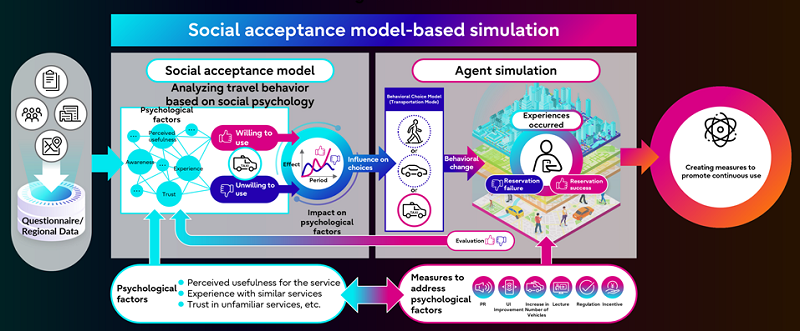
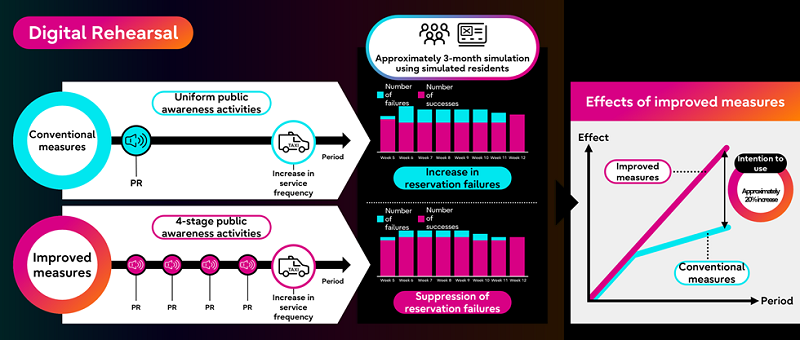
Figure 1: Overview of social acceptance model-based simulation
Figure 2: Overview and results of the initiatives

Isao Kita, Director of the Comprehensive Policy Division, Kawanishi Town, Nara Prefecture, comments: “I believe that pre-emptive consideration of transportation policies based on digital rehearsal technology will make it easier for local governments to consider measures amidst increasingly complex social issues. The possibilities are fascinating.”

Future plans

By fiscal 2026, Fujitsu and Nagoya University will continue to conduct demonstration experiments and aim to develop this technology into a solution that suggests measures to improve adoption of new transportation services using data gained from small-scale resident surveys. Going forward, both parties will apply this technology to the design of public services in a wide range of fields, including healthcare, medicine, urban development, and environmental measures, in addition to the mobility sector, thereby improving people’s well-being through converging technologies that combine the digital realm and humanities and social sciences.

SHARE
Facebook
Twitter
  • tweet
Previous articleNew Vishay Intertechnology Industrial-Grade 3/8 Inch Square Single-Turn Cermet Trimmer Optimizes Placement on PCB
Next articleAstute Group Sign Alp Lab in Edge AI Expansion
Editor

RELATED ARTICLESMORE FROM AUTHOR

ultralow-power image sensors
Technology

STMicroelectronics brings always-on vision to next-generation personal electronics with new ultralow-power image sensors

Ultra-Compact Wireless Power Chipset
Semiconductor

ROHM Launches an Ultra-Compact Wireless Power Chipset for Wearables

Autonomous Operations Powered by AI
Technology

Autonomous Operations Powered by AI: Microland Unveils Blueprint for AI-First Enterprise Transformation

Technology

ECSite Announces Advanced Automation Integration with VIAVI Solutions to Accelerate Hyperscale Data Center Fiber Testing

AI in Mining Industry Africa
Artificial Intelligence

AI in Mining Industry Africa to Take Center Stage at African Mining Week 2026

Synopsys TSMC AI Partnership
Artificial Intelligence

Synopsys TSMC AI Partnership Drives Next-Gen AI Systems with Advanced EDA and Silicon IP

Interview

Luca Rodeschini

STMicroelectronics Debuts First Automotive MCU with Integrated NPU for AI-Driven Powertrains

March 30, 2026
Bhupinder Singh

India’s Electronics Powerplay: Why 2026 Will Set the Industry Pace

March 24, 2026
Mr. Vinkesh Gulati

Building the Future of Automotive Skills in India: ASDC

March 13, 2026
Chhavi Bajpai

From Semiconductor Leadership to Social Impact: Chhavi Bajpai’s Journey in Technology...

March 9, 2026
Arindam Lahiri, CEO, ASDC

Building India’s Automotive Workforce for a Technology-Driven Future

March 7, 2026
ABOUT US
Electronics News in India | www.electronicsmedia.info, An electronics and technology news magazine and portal, covers news from electronics industry. Subscribe our news letter to get news direct in your inbox. Stay updated with latest industry trend and technology.
Contact us: info@digielectromedia.com
FOLLOW US
  • Live Streaming
  • Webinar Promotion
  • Privacy Policy
  • Contact us
© Copyright 2016 - 2025 Digi Electro Media All Rights Reserved.
MORE STORIES
PEMTRON AI-Driven Inspection Solutions

PEMTRON AI-Driven Inspection Solutions to Take Center Stage at SMTA Ciudad...

May 9, 2026
RF Testing Innovations Forum 2026

Rohde & Schwarz to host RF Testing Innovations Forum 2026, helping...

May 9, 2026

PCB Design Software Market To Reach USD 4.23 billion by 2033

May 9, 2026
We use cookies to ensure that we give you the best experience on our website. If you continue to use this site we will assume that you are happy with it.