

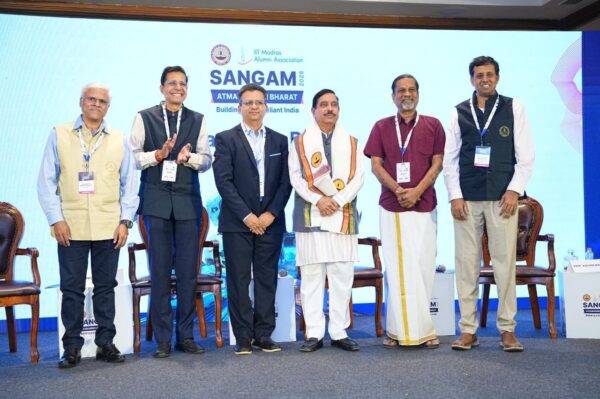
IITMAA Sangam 2026 – The 7th edition of IITMAA Sangam, the flagship annual conference of the IIT Madras Alumni Association (IITMAA), concluded today at the Taj MG Road in Bengaluru as a resounding success, uniting top national leaders, industry titans, and innovators around India’s self-reliance agenda. Centered on the national ambition of “Atmanirbhar Bharat – Building a Self-Reliant India” the summit convened an influential gathering of policymakers, corporate leaders, technology pioneers, professors, startups, and academic experts to address the pivotal drivers required to secure India’s strategic and economic independence.
Setting a high-impact tone for the summit, the grand inauguration was led by Shri Pralhad Joshi, Honourable Minister of Education, Government of India; Vice Admiral Sanjay Sadhu, Controller of Warship Production & Acquisition, Indian Navy; Prof. V. Kamakoti, Director, IIT Madras; Dr. Sridhar Vembu, Chief Scientist & Co-founder, Zoho Corporation, Ms. Goda Ramkumar, VP Data Science Flipkart; Prof. M Vidyasagar, FRS; Dr. Pratyush Kumar, Co-Founder, Sarvam AI and more.
The day’s deliberations spanned critical sectors central to national growth, including artificial intelligence, defence technologies, space exploration, digital financial infrastructure, semiconductor manufacturing, and sustainable infrastructure.
Smt. Nirmala Sitharaman, Honourable Minister of Finance & Corporate Affairs, Government of India, said, “India’s transformation has been driven by sustained efforts to clean up institutions, restore confidence, and open sectors to private participation, while creating policies that enable young people, entrepreneurs, and innovators to contribute to growth. The opening of the space sector is a strong example, with Indian startups now designing and building satellites and undertaking space missions. Going forward, the next large investments in India’s infrastructure must focus heavily on AI, semiconductor chips, and quantum computing. Our MSMEs, which produce everything from basic components to aircraft parts, need AI solutions to improve productivity and compete globally, while pre-revenue deep-tech and hardware startups require patient capital and new early-stage funding mechanisms. Technology and innovation must reach every sector, from agriculture and renewable energy to advanced manufacturing. IITMs initiative to create a fund to handhold startups exemplifies how academia, industry, and government can work together. India can achieve 10%+ GDP growth, but this will require greater effort across all sectors and sustained collaboration to turn talent, technology, and innovation into growth.”
Shri Pralhad Joshi, Honourable Minister of Education, Government of India, said, “IITMAA Sangam 2026 is a key convergence point for technology, academia, industry, entrepreneurship, and public service, supporting India’s journey towards self-reliance and Viksit Bharat 2047. India’s electricity generation capacity has grown from 249 GW in 2014 to 552 GW today, including around 310 GW of non-fossil capacity, while the grid has recently managed a peak demand of 281 GW, with nearly one-third met through renewable energy. This growing infrastructure is enabling technological self-reliance, domestic manufacturing, and innovation. IIT Madras exemplifies this transformation with 560 startups, including 109 incubated in 2025–26, a collective valuation of ₹80,000 crore, 472 patents, and ₹950 crore in alumni contributions. At the heart of Sangam is this same spirit of Atmanirbhar Bharat, with discussions spanning AI, defence, infrastructure and other critical areas. This is also part of IITMAA’s larger effort to deepen alumni engagement, with our chapter network growing from 16 to 51 chapters over the past three years. Sangam is ultimately about connecting this powerful IIT Madras community and turning ideas, conversations and relationships into meaningful contributions towards Viksit Bharat.
Dr. Sridhar Vembu, Chief Scientist & Co-founder, Zoho Corporation, said, “National security today is entirely tech-driven, and critical foreign dependencies can be weaponized against us. In modern conflicts, nations leveraging an 80% to 90% dominance in commercial drones can deploy $50,000 military units against $50 million defense systems, a 1,000x cost disparity that underscores the power of hyper-massive industrial scale.
While software hiring in the Bay Area has contracted over the past 3 to 4 years outside of AI, automation itself is not a threat, it is the engine of prosperity. However, productivity gains only benefit citizens if we defeat tech monopolies. Foreign card networks extract 3.5% to 4% fees, whereas India’s NPCI processes over 25 billion monthly UPI transactions at near-zero cost on a lean ₹4,000 to ₹5,000 crore budget. Without indigenous alternatives to foreign platforms and monopolies, we risk economic extraction and platform kill-switches. Developing deep tech across every sector is non-negotiable for India’s national and economic sovereignty.”
Emphasizing the core vision of the summit, Mr. Sridhar Boovaraghavan, President of IITMAA & Chair of Sangam 2026, said, “Reflecting on the remarkable growth and success of Sangam 2026, it is clear that our alumni community remains deeply committed to advancing India’s self-reliant future. Beyond facilitating strategic dialogues across policy, technology, and industry, a defining milestone of this year’s summit is the scaling of our campus mentorship ecosystem. By expanding our Career and Life Coaching (CLIC) initiative, we are taking a definitive step toward ensuring that every single student at IIT Madras is paired with a dedicated alumni mentor for lifelong personal, academic, and professional guidance.”
Prof. V. Kamakoti, Director, IIT Madras, highlighted the institution’s role in expanding access to technology education and building India’s innovation ecosystem. IIT Madras’ programmes have reached around 53,000 students, while NPTEL-SWAYAM courses serve around 1.5 million learners. He also noted that IIT Madras has filed more than 400 patents in the last three financial years and incubated 583 startups with a combined valuation of around ₹83,000 crore, with 75% of startups incubated in the last two years coming from outside IIT Madras.
Throughout the day, high-impact panel discussions and fireside sessions evaluated critical themes such as sovereign AI development, next-generation maritime trade, advanced defence capabilities, and semiconductor supply chains, featuring insights from organizations like Reliance Intelligence, Flipkart, NVIDIA, Texas Instruments, and Tata Electronics.
Through our 500 MW portfolio spanning 300+ projects across 18 states including flagship deployments for partners like BigBasket, CtrlS Data Centres, Flipkart, and Toyota Kirloskar Motor, we have proven that clean energy can replace expensive diesel backup and handle continuous round-the-clock operational loads. Whether through group captive models or on-site storage microgrids, U-Solar enables businesses to lock in 20% to 30% power savings, insulate balance sheets against rising utility tariffs, and achieve auditable Scope 2 decarbonization. As we scale toward our 3 GW vision by 2032, U-Solar is committed to being the long-term energy partner C&I leaders trust for reliable, intelligent, and cost-predictable clean power.”
The event culminated this evening with a prestigious award ceremony followed by a grand cultural performance by acclaimed musician Guitar Prasanna.