

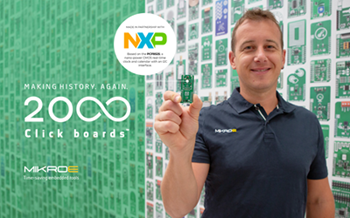
RTC 27 Click – MIKROE, the embedded solutions company that dramatically cuts development time by providing innovative hardware and software products based on proven standards, today launched its 2000th Click board™, the RTC 27 Click, designed for low-power real-time clock and calendar functionality, time tracking, alarm event generation, watchdog timing, and timestamp capture.
The Click board concept centres around the mikroBUS™ socket and standard, and was pioneered 15 years ago when Neb Matic, MIKROE CEO & Founder of MIKROE asked himself a question: ‘What is the minimum number of pins that can cover the greatest number of peripherals?’ The answer, he determined, was 16, in two rows of 8. This is the fewest number of pins that can account for most chips, modules, and components that designers could ever want to place on an add-on board. From this, MIKROE has developed the Click board product range such that the company now launches one new Click nearly every day.
Comments Aleksandar Mitrovic – Click boards Product Marketing Manager at MIKROE: “This large product range enables embedded designers to address a huge number of applications quickly and simply. This design approach is easy to access and cost-effective when compared to the price of bespoke design tools that are limited to products from one company. Designers can get up and running within minutes, without having to constantly learn new tools.”
RTC Click is the latest addition to the Click board family of compact add-on boards that enables developers to rapidly provide proof-of-concept, then prototype and code the new embedded projects. RTC 27 Click is based on the PCF8525, a nano-power CMOS real-time clock and calendar with an I2C interface from NXP. It provides year, month, day, day, weekday, hours, minutes, seconds, and 1/100-second data, selectable crystal temperature compensation with aging offset support for improved timekeeping accuracy, programmable alarm and watchdog timer functions, timestamp capture, battery backup with automatic switch-over circuitry, and two configurable interrupt outputs with selectable routing through onboard jumpers. Its ultra-low-power operation, requiring only 64 nA typical current consumption in timekeeping mode at 3.3 VDD, makes it especially suitable for battery-powered and always-on designs. RTC 27 Click is suitable for portable instruments, wearable devices, industrial systems, and IoT applications requiring reliable, low-power, and accurate timekeeping. The board also features the ClickID function which enables automatic identification by the host system, simplifying use. Devices can be used on any host system supporting the mikroBUS™ standard, and come with the mikroSDK open-source libraries, offering excellent flexibility for evaluation and customization.
Adds Alejandro Kelly, Smart Analog Interfaces (SAI) Technical Marketing Manager at NXP: “Our strategic partnership with MIKROE has ensured that many of our latest MCUs and ICs are now supported in MIKROE’s NECTO Studio IDE through the Click board™ program, which saves design time and cost by standardizing development tools, and ensures we can reach more people. Featuring the PCF8525 RTC IC, the RTC 27 Click provides highly accurate timekeeping to solve real-world challenges quickly and efficiently.”
For more information visit: www.mikroe.com.