

The electronics industry is evolving faster than ever. As devices become smaller, smarter, and more powerful, manufacturers face increasing pressure to produce miniature components with exceptional precision, reliability, and consistency.
From advanced connectors and sensor systems to RF devices and industrial electronics, precision machining has become a critical part of modern electronics manufacturing. Among the various machining technologies available today, Swiss machining stands out as one of the most effective solutions for producing complex, high-tolerance electronic components.
Engineering-focused technology platforms such as Electronics Media continue to highlight the growing role of precision manufacturing in supporting next-generation electronics production.
The Demand for Precision in Electronics Components
Modern electronic products rely on highly engineered mechanical parts that must fit and function perfectly within compact assemblies. Even a minor dimensional variation can impact conductivity, signal performance, thermal stability, or overall device reliability.
This is especially important in applications such as:
- Electronic connectors
- Sensor housings
- RF shielding components
- Medical electronics
- Automotive electronics
- Industrial automation systems
Communication equipment
As products become increasingly miniaturized, traditional machining methods often struggle to maintain the tolerances and surface finishes required for high-performance electronic assemblies.
Swiss machining technology solves many of these challenges by providing superior precision and stability during production.
What Makes Swiss Machining Different?
Swiss machining was originally developed for producing small, complex, and highly precise parts. Unlike conventional CNC turning, Swiss-type lathes support the material close to the cutting tool, significantly reducing vibration and improving machining accuracy.
This allows manufacturers to produce components with:
- Extremely tight tolerances
- Excellent concentricity
- Smooth surface finishes
- Complex geometries
- High repeatability
- Efficient high-volume production
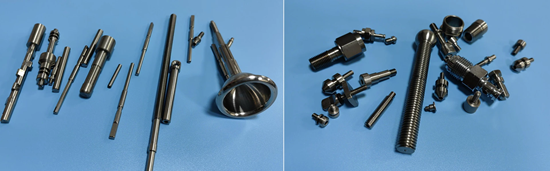
Swiss machining is particularly effective for long, slender, and miniature components commonly used in electronics and connector manufacturing.
Swiss Machined Components in Electronics Applications
Electronics manufacturers increasingly rely on Swiss machining because of its ability to support both precision and scalability.
Common applications include:
Connector Pins and Contacts
Precision-machined connector components require exact dimensions and consistent conductivity. Swiss machining enables stable production of miniature pins, contacts, and terminals with high repeatability.
Sensor and Instrumentation Components
Many industrial and medical sensors contain miniature shafts, threaded housings, and precision sleeves that require micron-level accuracy.
RF and Communication Equipment
Modern communication systems depend on tightly machined shielding and conductive components to maintain signal integrity and minimize interference.
Automotive Electronics
Electric vehicles and advanced driver-assistance systems require highly reliable electronic assemblies that incorporate precision-machined metal parts capable of operating in demanding environments.
Material Flexibility for Electronics Manufacturing
Swiss machining also supports a wide range of materials commonly used in electronics applications, including:
- Brass
- Stainless steel
- Aluminum
- Copper alloys
- Titanium
- Engineering plastics
This flexibility allows manufacturers to optimize components for conductivity, corrosion resistance, strength, or weight reduction depending on the application requirements.
Why OEMs Choose Specialized Precision Machining Suppliers
Electronics manufacturers increasingly prefer specialized machining partners that understand the strict quality requirements of electronic assemblies.
Reliable suppliers offer advantages such as:
Tight process control
Advanced inspection systems
Stable dimensional consistency
Fast prototyping capability
Scalable production capacity
Engineering support for manufacturability
Manufacturers producing high-precision turned components for electronics and industrial applications continue to play an important role in modern supply chains. Companies such as Falcon CNC Swiss support OEMs requiring tight-tolerance custom metal parts for demanding applications.
The Future of Precision Electronics Manufacturing
As electronics continue moving toward miniaturization, automation, and higher performance, the demand for precision-machined metal components will continue to increase.
Swiss machining technology remains one of the most effective manufacturing solutions for producing the complex, miniature, and high-tolerance components required by today’s advanced electronic systems.
For electronics manufacturers seeking reliable precision, scalability, and engineering-quality production, advanced Swiss machining capabilities are becoming an increasingly important part of the modern manufacturing supply chain.